
5 Best Pressure Washing Tools for Business Parks
Table of Contents
Why Pressure Washing Tools Matter for Business Park Maintenance
Choosing the Right Commercial Pressure Washer for Your Site
Gas-powered versus electric models: Operating hours and tenant impact
PSI and flow rate specifications: Matching productivity to site size
Access, hose routing, and working around vehicles
Surface Cleaners: Efficiency Beyond the Standard Lance
Tackling Oil Stains: Specialist Equipment and Techniques
Degreaser types and application methods
Environmental compliance and wastewater containment
Cost and productivity on stained car parks
Essential Safety Equipment and Pressure Washing Safety Precautions
Building Your Complete Business Park Cleaning Kit
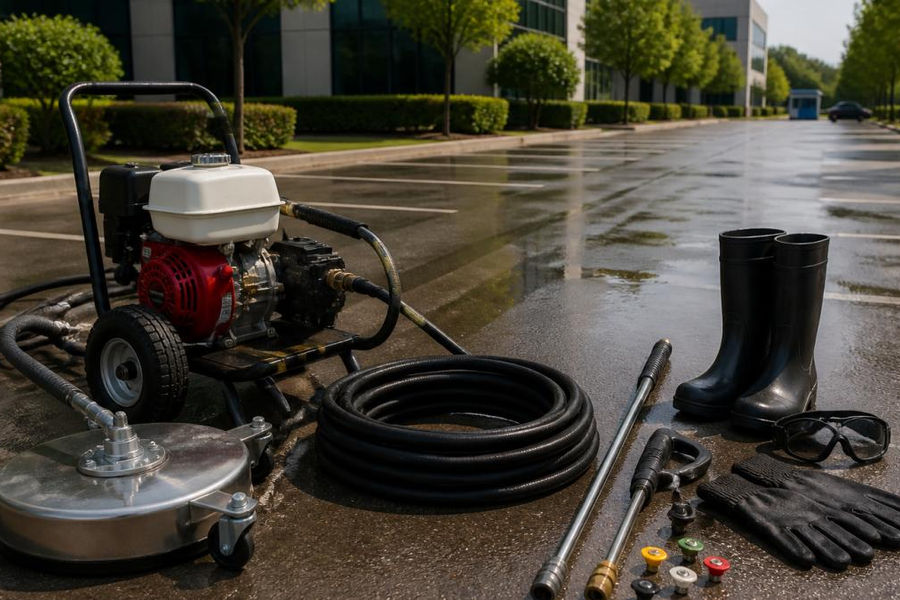
Hoses, nozzles, and extension wands
Water recovery and drainage management
Maintenance, Durability, and Total Cost of Ownership
Frequently Asked Questions
Last Updated: October 10, 2026
Why Pressure Washing Tools Matter for Business Park Maintenance
Keeping business park grounds presentable requires more than occasional sweeping. Dirt, algae, oil stains, and weathered surfaces accumulate quickly on concrete car parks, walkways, and building facades. The right pressure washing tools address this challenge directly. The right equipment transforms maintenance from reactive cleanup into consistent, efficient upkeep that protects your property investment.
Pressure washing isn't simply about removing visible grime. Regular cleaning prevents surface deterioration, extends the lifespan of concrete and asphalt, and maintains the professional appearance that clients notice immediately upon arrival. Business parks with well-maintained grounds report higher tenant satisfaction and stronger first impressions.
Pro Tip The most effective business park cleaning programs combine multiple tools rather than relying on a single pressure washer. A complete kit handles oil stains, large surface areas, and delicate landscaping without compromising results.
Choosing the Right Commercial Pressure Washer for Your Site
A commercial pressure washer forms the foundation of any business park cleaning operation. However, selection criteria differ significantly from general commercial work because business parks are occupied environments with active tenants, vehicle traffic, and shared facilities. The key is matching machine specifications to your actual workload, site constraints, and operational windows rather than buying maximum power you'll never use.
Gas-powered versus electric models: Operating hours and tenant impact
Gas-powered washers deliver higher PSI and sustained performance across long working days, handling heavy-duty cleaning tasks on concrete car parks without power limitations. A typical gas-powered commercial washer produces 85-95 decibels of noise, equivalent to a lawnmower or heavy traffic. According to the Health and Safety Executive (HSE), prolonged exposure to noise levels above 85 dBA requires hearing protection.
Electric models operate at 75-80 decibels, roughly equivalent to a vacuum cleaner, and produce zero emissions. They work well for routine maintenance during business hours, building facades, and areas where noise sensitivity is high.
For business parks with multiple zones and mixed surface types, many facilities managers adopt a hybrid approach: a gas-powered washer for intensive car park work scheduled outside business hours, and an electric model for regular maintenance, building cleaning, and tenant-facing areas during the day.
PSI and flow rate specifications: Matching productivity to site size
PSI (pounds per square inch) determines cleaning force. Flow rate measures water volume per minute (GPM). Together, they define both cleaning capability and area-coverage speed, a critical factor for business park economics.
Most business park applications require 2,500 to 3,500 PSI. This range removes oil, algae, and embedded dirt without damaging concrete or asphalt. Higher PSI (4,000+) risks surface erosion and is unnecessary for routine maintenance.
Flow rate between 3.5 and 5 GPM balances cleaning speed with water efficiency.
Higher flow rates cover large areas faster but increase water consumption and runoff, a consideration for sites with drainage restrictions or water-metering charges.
Watch Out Excessive PSI damages concrete surfaces, creating micro-fractures that accelerate deterioration. Start with moderate pressure and increase only if results are insufficient. On decorative or sealed concrete, test in an inconspicuous area first.
Access, hose routing, and working around vehicles
Business parks present logistical challenges that home or small-business pressure washing does not. Hose length, power cord reach, and equipment positioning must navigate parked vehicles, pedestrian pathways, and building layouts.
Electric models require proximity to a power outlet or rely on battery operation, limiting flexibility on large sites. Gas-powered washers are more mobile but need fuel storage and produce exhaust fumes, relevant if the machine will operate near air intakes or outdoor seating areas.
Schedule cleaning during off-peak hours when possible (early morning, weekends, or tenant-agreed windows) to minimise disruption to parking and vehicle movement. Communicate with tenants in advance, especially for building-facade cleaning or extended car park work that may restrict parking temporarily.
Surface Cleaners: Efficiency Beyond the Standard Lance
A standard pressure washer lance creates streaks and uneven cleaning patterns. Surface cleaners eliminate this problem by applying consistent pressure across a wide footprint.
Surface cleaners attach to your pressure washer and feature rotating jets that clean in a circular pattern. They cover 15 to 24 inches of ground per pass, making large car parks dramatically faster to clean than lance-only methods. The result is uniform appearance without visible lines or missed patches.
For business parks, surface cleaners reduce labour time on concrete car parks and walkways.
Tackling Oil Stains: Specialist Equipment and Techniques
Oil stains persist on car park surfaces because pressure alone cannot dissolve hydrocarbon deposits. Specialist degreasing agents combined with targeted equipment and proper containment are necessary, and increasingly, environmental regulations require careful handling of wastewater and chemical runoff.
Degreaser types and application methods
Commercial degreasers fall into three categories: alkaline (general-purpose, safe for most surfaces), solvent-based (heavy-duty for thick deposits), and bio-based (lower toxicity, slower acting). Alkaline degreasers are most common in business parks because they work on typical motor oil, grease, and fuel stains without harming concrete or landscaping.
Foam applicators deliver degreaser concentrate across the stained area in a controlled layer, allowing chemical action time (typically 10-15 minutes) to break down oil before pressure washing removes the residue. This dwell time is critical: rushing to pressure wash before the degreaser has worked wastes product and labour.
Turbo nozzles concentrate pressure into a narrow jet for intense scrubbing action on localised stains. They work best after degreaser application has softened the deposit.
Environmental compliance and wastewater containment
Business parks often sit within areas subject to environmental regulations governing stormwater runoff and wastewater discharge. The Environmental Permitting (England and Wales) Regulations 2016 and local drainage bylaws may restrict direct discharge of contaminated water into storm drains or watercourses. Many parks have drainage plans on file; consult these before beginning work.
Uncontained pressure-washing runoff containing oil residue and degreaser chemicals can:
Contaminate storm drains leading to local watercourses
Create slip hazards on adjacent pavements and car parks
Trigger regulatory fines or enforcement action if traced to your operation
Damage landscaping and affect neighbouring tenants
Proper containment requires portable berms (temporary barriers) or absorbent mats to capture runoff. For heavily stained car parks, a three-step approach minimises environmental risk:
Apply degreaser and allow dwell time (10-15 minutes) within a contained area using temporary berms or absorbent matting.
Use a turbo nozzle for initial scrubbing, directing runoff into the containment system.
Finish with a surface cleaner for uniform appearance, capturing final rinse water in the same containment.
Collected wastewater can be disposed of via:
Licensed waste-water disposal contractors
On-site treatment systems (if the park has approved facilities)
Evaporation in designated holding tanks (slower, suitable for low-volume stains)
Many business parks require evidence of proper disposal before approving pressure-washing work. Obtain written confirmation from your waste contractor and retain disposal certificates for compliance records.
Cost and productivity on stained car parks
A single large oil stain (1-2 square metres) typically requires 30-45 minutes of labour including degreaser application, dwell time, scrubbing, and containment setup. A heavily stained car park section (500+ stains) may take 2-3 days with a two-person team.
For business parks with recurring oil stains, preventative maintenance is more cost-effective than reactive deep cleaning. Regular light pressure washing (monthly or quarterly) removes fresh spills before they set into the concrete, reducing stain severity and cleaning time over time.
Key Takeaway The difference between a maintenance team and a professional operation is often environmental management. Proper containment, wastewater handling, and compliance documentation protect your liability, maintain tenant relations, and demonstrate responsible site stewardship.
Essential Safety Equipment and Pressure Washing Safety Precautions
Pressure washing equipment poses genuine hazards. Water jets at 3,000+ PSI can penetrate skin and cause serious injury. Proper safety practices protect your team and prevent liability issues.
Operators must wear eye protection rated for impact, closed-toe footwear with grip soles, and hearing protection when using gas-powered equipment. Long sleeves and trousers reduce exposure to spray and debris.
Never direct a pressure washer at people, animals, or electrical installations. Keep bystanders at least 10 metres away during operation. Inspect hoses before each use for cracks or leaks that could fail under pressure.
Ground conditions matter. Wet surfaces become slippery; uneven ground increases trip hazards. Clear the work area of obstacles before starting.
Building Your Complete Business Park Cleaning Kit
A professional cleaning operation requires more than a pressure washer. Hoses, nozzles, surface cleaners, and drainage management form an integrated system that determines success.
Hoses, nozzles, and extension wands
High-pressure hoses rated for your washer's PSI prevent dangerous failures. Reinforced hoses with quick-connect fittings allow rapid nozzle changes without stopping the engine.
Nozzle kits include multiple angles: 0 degrees for maximum force on stubborn stains, 15 degrees for general cleaning, 25 degrees for delicate surfaces, and 40 degrees for rinsing. Colour-coded nozzles make selection quick during work.
Extension wands reach second-storey facades and high guttering without ladders. Most commercial setups include 1 to 2 extension options for varied applications.
Water recovery and drainage management
Pressure washing generates significant runoff containing dirt, oil, and cleaning chemicals. Unmanaged water creates slip hazards, contaminates surrounding areas, and may violate environmental regulations.
Water recovery systems capture and filter runoff for safe disposal or reuse. Portable containment berms prevent contaminated water from flowing into storm drains or landscaped areas. For car parks with oil stains, proper drainage management is essential to compliance.
Many business parks require drainage plans before pressure washing begins. Consulting your site's drainage infrastructure and environmental requirements prevents costly cleanup or regulatory issues.
Key Takeaway The difference between a maintenance team and a professional operation is often drainage management. Proper water handling protects your liability and maintains good relationships with neighbouring tenants.
Maintenance, Durability, and Total Cost of Ownership
Equipment purchase price is only part of the total cost. Maintenance, repair, and replacement cycles determine long-term value.
Gas-powered washers require seasonal servicing, spark plug replacement, and regular oil changes. Parts availability and service costs vary by brand.
Commercial-grade equipment from established manufacturers typically lasts 5 to 10 years with proper maintenance. Budget for annual servicing, replacement hoses, and nozzle wear.
Calculate total cost of ownership by adding purchase price, annual maintenance, and expected parts replacement over the equipment's lifespan. Compare this against rental costs for your actual usage pattern.
Maintaining professional grounds across a business park demands reliable equipment and consistent processes. The right pressure washing tools reduce labour time, improve results, and protect your property investment.
Frequently Asked Questions
What PSI pressure washer do I need for a business park car park?
Most business park car parks require 3000-4000 PSI for effective cleaning of concrete, tarmac, and light oil marks. Higher PSI (up to 5000) tackles stubborn stains and algae but risks surface damage if pressure is not controlled. A commercial pressure washer with adjustable pressure and a surface cleaner attachment gives you flexibility to match the cleaning task. Always test on a small area first to confirm the setting suits your specific surface.
Is a surface cleaner better than a standard pressure washer lance for large paved areas?
Yes, for business park car parks and large paved areas, a pressure washer surface cleaner is significantly more efficient. It covers 60-90 cm width in a single pass, delivers even pressure across the entire width, and reduces streaking and uneven cleaning. A standard lance requires overlapping passes and operator skill to avoid visible lines. For regular maintenance of large car parks, a surface cleaner saves time and labour costs while producing professional, consistent results.
How do you remove oil stains from a commercial car park?
Oil stains require a multi-step approach: first, apply a degreasing agent designed for concrete and let it sit for 10-15 minutes to break down the oil. Then use a pressure washer at 3000-4000 PSI with a turbo nozzle or surface cleaner to agitate and lift the loosened oil. For stubborn stains, repeat the process or use a hot-water pressure washer, which is more effective on set-in oil. Always check drainage and environmental compliance requirements before washing, as oil-contaminated runoff requires proper containment or recovery.
What safety precautions are needed when pressure washing a shared car park?
Essential pressure washing safety precautions include: wearing safety glasses, steel-toed boots, and gloves to protect against high-pressure spray and debris; checking the area for trip hazards and securing the hose to prevent accidents; notifying tenants or staff before starting to avoid surprise exposure; using low-pressure nozzles (25-40 degrees) near people or parked vehicles; ensuring proper drainage to prevent slippery surfaces; and following all manufacturer guidance for your equipment. If working during business hours, cordoning off the work area and using high-visibility clothing is mandatory.
TELL US Submit

Comments