
Car Park Maintenance Best Practices: A 2026 Guide
Updated: Sep 16
Table of Contents
Why Regular Car Park Maintenance Matters
Creating a Car Park Maintenance Schedule Template
Monthly inspection and debris removal
Quarterly surface and drainage checks
Annual structural assessment
Car Park Health and Safety Regulations UK: Compliance Requirements
Slip and trip hazard prevention
Lighting and visibility standards
Wayfinding signage and emergency routes
Surface and Decking Maintenance for Long-Term Durability
Addressing cracks and pothole repair
Oil and grease removal techniques
Concrete sealing and protective coatings
Winter Gritting Requirements for Car Parks
Timing and application rates for grit
Managing snow and ice safely
Drainage and Water Management Systems
Preventing surface water accumulation
Clearing debris from drainage channels
Line Marking and Bay Identification Maintenance
Cost of Car Park Resurfacing UK and Budget Planning
Lifecycle cost analysis and preventative investment
When to resurface versus repair
Last Updated: August 5, 2026
Why Regular Car Park Maintenance Matters
A well-maintained car park protects property value, reduces liability, and signals professionalism to clients. Neglect compounds quickly: small cracks become potholes, pooling water becomes structural damage, and slip hazards become insurance claims. Regular inspections catch problems early, scheduled maintenance spreads costs predictably, and documented compliance protects you legally.
This guide covers practical car park maintenance for UK commercial sites. Whether managing an office park in the Thames Valley or a business complex in Berkshire, preventative maintenance is always cheaper than emergency repair.
Pro Tip Address surface deterioration before it reaches the decking layer. Once water penetrates the wearing course, repair costs multiply by 5-10x. Monthly visual inspections take 30 minutes and catch 90% of emerging problems.
Creating a Car Park Maintenance Schedule Template
A maintenance schedule is your operational backbone. Without one, tasks slip, compliance gaps appear, and you're always reacting to crises.
Monthly Inspection and Debris Removal
Monthly inspections are your early warning system. They're quick, low-cost, and catch problems when still manageable.
What to inspect: Surface condition (cracks, potholes, rutting), drainage (clear gullies, pooling water), line markings, debris, signage legibility, and lighting functionality.
Debris removal: Sweep drainage channels monthly, twice monthly after autumn leaf-fall. Remove immediate hazards same-day.
Documentation: Take photos of the same zones each month. A simple spreadsheet with date, section, issue, and action taken justifies resurfacing decisions to stakeholders or insurers.
Key Takeaway Monthly inspections take 45 minutes for a medium car park and cost nearly nothing. They prevent 80% of emergency call-outs.
Quarterly Surface and Drainage Checks
Quarterly maintenance addresses small issues before escalation and tackles seasonal challenges.
Surface checks: Examine cracks (hairline cracks under 3mm can be sealed; larger cracks need professional assessment), look for spalling or exposed aggregate, check for rutting in high-traffic zones, and assess patched areas.
Drainage focus: Clear all drainage channels of silt, leaves, and debris. Check that water flows freely toward gullies. For permeable surfaces, inspect for compaction or blockage. Listen for gurgling or slow drainage, signs of deeper blockage.
Grease and oil removal: Use appropriate degreasing products on stained areas, focusing on bays near vehicle entry points and loading zones. Oil and grease break down asphalt binder and accelerate deterioration.
Timing: Schedule checks in late February, late May, late August, and late October.
Annual Structural Assessment
Once yearly, bring in professional assessment to inform longer-term budget and resurfacing decisions.
What a structural assessment covers: Core sampling or ground-penetrating radar to assess sub-base integrity, detailed crack mapping, drainage system performance, skid resistance testing, recommendation on remaining surface life, and identification of subsidence or movement.
Why professional assessment matters: You can spot surface problems yourself. You cannot reliably assess subsurface conditions or structural foundation integrity. A professional survey costs £400-800 for a medium car park but provides data to make informed decisions about £30,000-60,000 resurfacing.
Documentation: Keep this report as your baseline. Next year's assessment shows whether deterioration is stable or accelerating, driving capital planning and budget justification.
Maintenance Task | Frequency | Duration | Key Benefit |
Visual inspection and debris removal | Monthly | 45 minutes | Early problem detection |
Drainage clearing and surface checks | Quarterly | 2-3 hours | Prevents water damage |
Oil and grease removal | Quarterly | 1-2 hours | Extends surface life |
Professional structural assessment | Annually | 4-6 hours | Informs capital decisions |
Line marking refresh | As needed (typically annually) | 3-4 hours | Maintains safety and compliance |
Car Park Health and Safety Regulations UK: Compliance Requirements
Your car park is a workplace under UK health and safety law. The Health and Safety at Work etc. Act 1974 and the Management of Health and Safety at Work Regulations 2015 apply to you as occupier or operator. You have a legal duty to ensure, so far as reasonably practicable, the health and safety of anyone using your car park.
Slip and Trip Hazard Prevention
Slip and trip hazards are the leading cause of car park injuries and entirely preventable with systematic maintenance.
Surface defects as hazards: Potholes, raised edges, broken asphalt, and uneven concrete are trip hazards. Potholes deeper than 25mm should be repaired promptly. Raised edges or lips exceeding 12mm at joints require attention.
Water and moisture management: Standing water creates slip hazards and accelerates deterioration. Effective drainage prevents pooling. In winter, ice formation on water-logged areas creates serious slip risks.
Gritting and de-icing: During winter months, you have a duty to grit or salt surfaces where ice is likely to form. Document your gritting schedule, products used, and weather conditions.
Debris and contamination: Loose debris, spilled oil, and grease residue increase slip risk. Regular sweeping and cleaning are safety measures.
Lighting and Visibility Standards
Adequate lighting is both a safety requirement and security measure. Poor lighting increases trip and slip risks, enables criminal activity, and signals neglect.
Minimum standards: Industry guidance (BS 5489-1) recommends 20-50 lux for covered car parks and 20-75 lux for open-air car parks. Non-functional lights must be repaired promptly. Replace failed units within one week.
Emergency lighting: If your car park has emergency lighting (required in multi-storey structures), test it monthly and maintain it to the same standard as main lighting.
Watch Out A single slip injury claim in a poorly lit car park can cost £5,000-25,000 in compensation and legal costs, plus increased insurance premiums. Lighting maintenance is preventative risk management.
Wayfinding Signage and Emergency Routes
Clear wayfinding reduces confusion, prevents accidents, and ensures safe emergency exit.
Required signage: Emergency exit signs (illuminated, meeting BS 5499-1 standards), fire assembly point signs, speed limit signs (typically 10 mph), one-way traffic direction signs, disabled bay identification, no-parking zone markings, and reserved space signage.
Maintenance: Signs must be legible, secure, and properly illuminated where required. Inspect quarterly and replace damaged signage within two weeks.
Emergency routes: Ensure designated emergency routes are never obstructed. Keep emergency exits clearly signed and accessible at all times.
Surface and Decking Maintenance for Long-Term Durability
The surface of your car park is under constant stress from vehicle weight, temperature cycles, moisture infiltration, and UV exposure. The difference between a car park lasting 15 years and one lasting 25 years is maintenance discipline.
Addressing Cracks and Pothole Repair
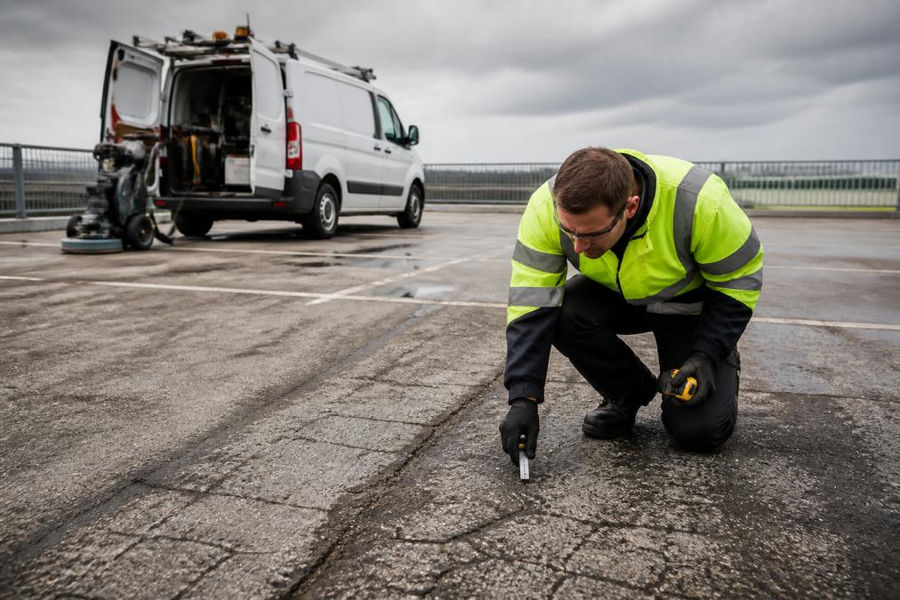
Cracks allow water infiltration, which accelerates deterioration exponentially. Addressing cracks early is one of the highest-return maintenance investments.
Crack classification and action:
Hairline cracks (under 3mm): Seal with flexible sealant. Cost: £20-40 per 10 metres.
Moderate cracks (3-10mm): Clean out debris, apply crack filler, then seal. Cost: £50-100 per 10 metres.
Wide cracks (over 10mm) or spalling: Professional assessment needed. Cost: £150-300 per repair.
Pothole repair process: Cut out damaged area to solid edges, clean out debris, apply tack coat, fill with appropriate material, compact firmly, and seal edges.
Timing matters: Repair potholes before winter. Winter freeze-thaw cycles make potholes worse. A 50mm pothole in November becomes 150mm by March if left untreated.
Oil and Grease Removal Techniques
Oil and grease chemically break down asphalt binder, accelerating surface failure. They also create slip hazards and environmental contamination.
Removal methods: Regular mechanical sweeping removes loose debris. High-pressure water (100-150 bar) removes surface grease. Specialized degreasing products break down oil bonds (cost: £30-60 per 100m²). Proprietary granules contain fresh spills effectively.
Environmental consideration: Direct runoff to permeable surfaces or soak-away areas where possible. For large contamination, consider professional remediation.
Concrete Sealing and Protective Coatings
If your car park is concrete, sealing is your primary defence against deterioration. Unsealed concrete is porous and absorbs water, salt, and contaminants, which freeze and expand, causing spalling and cracking.
Sealing schedule: Concrete should be sealed every 2-3 years. New concrete should be sealed within 6 months of installation.
Coating types:
Acrylic sealers: Budget-friendly, moderate durability (2-3 years). Cost: £15-30 per m².
Polyurethane coatings: Higher durability (4-6 years), better chemical resistance. Cost: £40-80 per m².
Epoxy coatings: Premium option, very durable (6-10 years), for high-traffic zones. Cost: £60-120 per m².
Application: Surfaces must be clean and dry before sealing. High-pressure wash first, allow 48 hours drying, then apply.
Pro Tip Sealing concrete costs £15-30 per m² and lasts 2-3 years. Repairing spalled concrete costs £100-200 per m². Seal regularly and avoid expensive repairs.
Winter Gritting Requirements for Car Parks
Winter creates slip hazards, reduces visibility, and accelerates surface deterioration through freeze-thaw cycles. You have both a legal duty and practical interest in managing winter conditions effectively.

Timing and Application Rates for Grit
Gritting follows logic based on temperature, precipitation, and traffic patterns.
When to grit: Grit before snow falls when temperatures are forecast below freezing. Grit after snowfall stops, not during. Grit when frost is forecast to form overnight. Grit after snow clearance to prevent re-freeze.
Application rates: Standard guidance suggests 10-15 grams per square metre for prevention and 20-30 grams per m² for existing ice treatment. For a 2,000 m² car park, that's 20-60 kg per application.
Product choice:
Rock salt (sodium chloride): Cheapest option, effective to approximately -10°C. Cost: £50-80 per tonne.
Calcium chloride: Works at lower temperatures (-20°C), faster acting, more expensive. Cost: £150-250 per tonne.
Grit (aggregate): Provides traction without melting ice, environmentally preferable. Cost: £30-60 per tonne.
Documentation: Record every gritting event: date, time, product used, amount applied, weather conditions, and who applied it. This documentation is your defence if a slip injury claim arises.
Managing Snow and Ice Safely
Snow clearance is labour-intensive but necessary. Accumulated snow reduces parking capacity, creates visibility problems, and damages surfaces if left to freeze and thaw repeatedly.
Snow clearance priorities: Emergency routes first, main traffic routes and circulation areas, individual parking bays, then peripheral areas.
Equipment options:
Manual labour: Effective for light snow (under 50mm). Cost: £15-25 per hour per person.
Snow plough: Efficient for heavy snow, requires trained operator. Cost: £300-600 per visit.
Rotary broom: Removes snow and grit in one pass. Cost: £200-400 per visit.
Timing: Clear snow as soon as practical after it stops falling. Snow left 24 hours compacts into ice, which is harder to remove and more dangerous.
Safety during clearance: Ensure personnel wear high-visibility clothing. Position vehicles so they don't create new hazards. Never push snow into traffic lanes or pedestrian areas.
Drainage and Water Management Systems
Water is your car park's worst enemy. It infiltrates surfaces, destabilizes sub-bases, corrodes reinforcement, and creates slip hazards. Effective drainage prevents all of this.
Preventing Surface Water Accumulation
Standing water indicates drainage failure and is actively causing damage.
Common causes of pooling: Blocked gullies or catch basins, broken or misaligned drainage pipes, settlement or subsidence creating low spots, inadequate slope (car parks should slope 1-2% toward drainage points), and permeable surface compaction.
Prevention and remediation: Monthly visual inspection after rain identifies areas where water sits over 30 minutes. Clear all gullies quarterly (more often in autumn). Check that slopes are maintained. For persistent pooling in the same spot, investigate subsurface issues, indicating possible structural movement. If you have permeable surfaces, pressure-wash annually to restore permeability.
Seasonal considerations: Spring and autumn are high-risk periods for drainage failure due to leaf accumulation. Winter freeze-thaw cycles can move pipes and create new low spots.
Clearing Debris from Drainage Channels
A blocked drainage channel is a ticking clock toward surface water damage.
Quarterly clearing process: Remove large debris by hand, sweep channels to remove silt and fine material, use a pressure washer (low pressure, 30-50 bar) to flush channels toward gullies, check that water flows freely, and inspect gully grates for blockage.
Autumn protocol: In October and November, increase clearing to twice monthly. Falling leaves clog channels rapidly.
Underground drainage: Signs of trouble include slow drainage after rain, gurgling sounds from gullies, or surface pooling despite clear surface channels. These warrant professional drain camera inspection and jetting. Cost: £300-600.
Line Marking and Bay Identification Maintenance
Line markings are safety features that define traffic flow, identify disabled bays, and communicate parking rules. Faded or missing markings create confusion and reduce safety.
Marking types and durability:
Paint: Lasts 12-18 months. Cost: £0.50-1.00 per linear metre.
Thermoplastic: Lasts 3-5 years. Cost: £2.00-4.00 per linear metre.
Resin-bound: Lasts 5-7 years. Cost: £3.00-6.00 per linear metre.
Maintenance schedule: Inspect markings quarterly. Repaint when coverage drops below 80%. Refresh disabled bays annually regardless of overall marking condition.
Bay numbering: Ensure numbers are legible from a vehicle. Replace faded or damaged numbers promptly. This is especially important in multi-storey car parks.
Cost of Car Park Resurfacing UK and Budget Planning
Resurfacing is your biggest car park maintenance expense. A 2,000 m² car park typically costs £30,000-60,000 depending on condition and material choice. Smart budget planning makes resurfacing predictable rather than a crisis.
Lifecycle Cost Analysis and Preventative Investment
The question isn't whether you'll resurface, it's when.
Typical surface lifespan:
Asphalt (well-maintained): 15-20 years. Cost per year: £1,500-4,000 for a 2,000 m² car park.
Asphalt (poorly maintained): 8-12 years. Cost per year: £2,500-7,500.
Concrete (well-maintained): 20-25 years. Cost per year: £1,200-3,000.
Concrete (poorly maintained): 12-15 years. Cost per year: £2,000-5,000.
Preventative maintenance ROI: Spending £3,000-5,000 annually on maintenance extends surface life by 5-7 years. That's a return of 6-10x your annual maintenance spend.
Budget framework for a 2,000 m² car park:
Annual maintenance (inspections, repairs, gritting, cleaning): £3,500-5,500
Resurfacing reserve (annual allocation): £2,000-3,500
Total annual car park budget: £5,500-9,000
Over a 20-year cycle, this averages £110,000-180,000 total. Without preventative maintenance, you'd face emergency resurfacing at £40,000-60,000 with minimal notice.
When to Resurface Versus Repair
The decision depends on cost, remaining life, and damage severity.
Repair is appropriate when: Damage is localized (under 20% of surface area), underlying structure is sound, remaining surface life is estimated at 5+ years, and repair cost is under 30% of full resurfacing cost.
Resurface when: Damage covers over 30% of surface area, professional assessment indicates structural deterioration, remaining surface life is estimated at under 3 years, or repair costs approach 50%+ of resurfacing cost.
Cost threshold: If repairs in a given year exceed £8,000-12,000 for a 2,000 m² car park, resurfacing is likely more cost-effective than continued patching.
Timing: Plan resurfacing during low-traffic periods if possible. Coordinate with other capital works to spread costs and disruption.
Maintaining a car park properly isn't glamorous, but it pays dividends. Every inspection skipped, every pothole deferred, and every drainage channel left clogged compounds into larger problems later. At Pemigogardens, we've built our reputation on reliability and consistency, the same approach that keeps car parks safe and functional for years. If you're managing a private office or business park in the M40/M4 corridor and want a team that shows up, follows a structured maintenance plan, and delivers results, we're here to help. TELL US what your site needs.
Frequently Asked Questions
What are the legal requirements for car park maintenance in the UK?
Car park owners must comply with the Health and Safety at Work etc. Act 1974 and the Equality Act 2010. This includes maintaining surfaces to prevent slip and trip hazards, ensuring adequate lighting, providing clear wayfinding signage, and managing drainage to prevent water accumulation. Structural integrity must be monitored through regular site surveys, and any deterioration that poses a risk must be addressed promptly. Working with a professional grounds maintenance team ensures compliance with these standards.
How often should a car park maintenance schedule include inspections?
Monthly inspections should check for debris, surface damage, and drainage blockages. Quarterly reviews should assess lighting levels, line marking clarity, and signage condition. Annual structural surveys by qualified professionals should examine sub-base integrity, crack development, and protective coating effectiveness. Regular inspections catch deterioration early, reducing repair costs and maintaining pedestrian safety. A formal car park maintenance schedule template helps track these intervals consistently.
What is the cost of car park resurfacing UK and how can I budget for it?
Resurfacing costs typically range from £25-£50 per square metre depending on surface type, damage extent, and location. A 100-space car park (approximately 3,000 square metres) may cost £75,000-£150,000. However, preventative maintenance reduces long-term costs significantly. Investing in regular cleaning, crack repair, and protective coatings extends surface life by 10-15 years. Lifecycle cost analysis shows that spending £2,000-£3,000 annually on maintenance prevents £80,000+ resurfacing expenses later.
What winter gritting requirements apply to car parks in the UK?
Winter gritting requirements for car parks depend on local authority guidance and site risk assessment. Generally, grit should be applied before ice forms (typically when temperatures drop below 2°C) at rates of 10-20 grams per square metre. Snow should be cleared promptly to maintain safe pedestrian and vehicle movement. De-icing products must be environmentally responsible where drainage connects to watercourses. Regular gritting and snow clearance reduce slip and trip hazards, protecting your site's users and reducing liability.
TELL US Submit
This article was written using GrandRanker



Comments