
Top 10 Biophilic Landscaping Trends for 2026
Table of Contents
Why Biophilic Landscaping Is Reshaping Commercial Grounds in 2026
Biophilic Design in Commercial Landscaping: The Principles Behind the Trends
1. Naturalistic Planting and Rewilding With Structure
2. Native Plants for Commercial Landscapes
3. Water-Wise Gardens and Rainwater Management
4. Sustainable Landscaping for Businesses: Measuring What You Save
5. Low-Maintenance Office Landscaping That Still Looks Considered
6. Outdoor Rooms and Functional Outdoor Spaces for Staff and Visitors
What This Means for Your Site in 2026
Frequently Asked Questions
Last Updated: October 17, 2026
Why Biophilic Landscaping Is Reshaping Commercial Grounds in 2026
Biophilic landscaping is the deliberate design of outdoor space around the human need to see, hear and touch living things. At Pemigogardens, we work on private office parks and business parks across the M40/M4 corridor, and the shift is obvious: grounds are no longer judged on tidiness alone. They are judged on how people feel walking from the car park to the front door.
The top 10 biophilic landscaping trends for in 2026 all point the same way. Structured meadow planting, native species, rainwater capture, edible borders and outdoor rooms are replacing the flat lawn-and-shrub model. The UK Green Building Council guidance on nature and wellbeing frames this as a commercial argument, not a decorative one: grounds that support biodiversity and daily contact with nature help buildings perform better for the people inside them.
Below, we break down each trend and, more usefully, what it means for maintenance budgets, site safety and how your grounds actually look in February.
Biophilic Design in Commercial Landscaping: The Principles Behind the Trends
Biophilic design in commercial landscaping rests on three principles: direct nature (real plants, water, weather), indirect nature (natural materials, timber, stone, views out), and space that invites people to pause. Every trend that follows is an application of one of those three.
That distinction matters because it separates genuine biophilic work from greenwashing. A row of boxed shrubs by a smoking shelter is not biophilic design. A planted threshold where staff eat lunch in shelter, with seasonal change they can see from a desk, is. The Building Research Establishment's work on environmental assessment treats ecology and health as measurable site criteria, which is a useful discipline: if you cannot point to what the planting does for people or wildlife, it is decoration.
1. Naturalistic Planting and Rewilding With Structure
The headline trend is the structured meadow: naturalistic planting given clear edges so it reads as designed, not neglected. Tamer meadows, sleek metal edging and a mown path through longer grass give you biodiversity without the complaints that follow a genuinely wild verge.

Rewilding on a commercial site needs containment. Our rule is simple: no more than a third of any visible frontage in relaxed planting, always bordered by mown lawn or hard edging, always with a sightline kept clear. That keeps the site defensible and keeps the biodiversity.
2. Native Plants for Commercial Landscapes
Native plants for commercial landscapes are the most reliable way to get seasonal interest, pollinator-friendly gardens and lower input costs at the same time. Native species are adapted to local soil and rainfall, so they establish faster and need less watering once they are in. But "native" is not a single look, and the difference between a native scheme that thrives and one that turns into a thicket is in the specification, not the plant list.
Start with the site, not the catalogue. A native border on heavy clay beside a car park has different constraints from a free-draining verge on a business park edge.
What most guides miss is that native planting still needs editing. A native border left entirely alone for three years becomes a thicket. We specify a maintenance rhythm from day one: cut back, divide, thin and replant. For a meadow-style border, that usually means a late-summer cut with arisings removed, a second tidy in early spring, and spot-weeding of aggressive grasses. For shrub and woodland-edge planting, it means formative pruning in the first two winters and a mulch top-up to suppress weeds while the canopy closes.
There is also a biophilic argument that goes beyond biodiversity. Native planting gives staff and visitors something to notice across the year, the first primrose, the hum of a knapweed border in July, seed heads left standing for birds in winter. That seasonal change is the point: it is direct nature, not a static green screen.
Cost-wise, native plug plants and small bare-root stock are typically cheaper per unit than mature ornamental shrubs, but the saving is only real if the aftercare is funded. A common pattern is to spend the budget on planting and then cut the maintenance visits, which is exactly how native borders get a reputation for looking scruffy. Match the planting to the maintenance budget, not the other way round.
3. Water-Wise Gardens and Rainwater Management
Water-wise gardens work by slowing rainwater down and keeping it on site. Rain gardens, swales, permeable paving and planted detention basins all do the same job: they hold water where it falls, feed the soil, and reduce pressure on drainage.
For a business park, the practical wins are fewer standing puddles in the car park, less summer irrigation, and planting that survives a dry August. Soil health is the foundation. Mulch beds, avoid compacting soil during construction, and plant in autumn so roots establish before the dry months. Irrigation, where you need it, should be drip-fed and zoned, not sprayed across a whole site at dawn.
4. Sustainable Landscaping for Businesses: Measuring What You Save
Sustainable landscaping for businesses only survives a budget review if you can show the numbers. Track three things: irrigation volume used per season, green waste removed per visit, and the proportion of beds under low-input planting.
A simple site scorecard keeps the conversation honest:
What to measure | How to record it | What it tells you |
Irrigation volume | Meter readings per zone, monthly | Whether water-wise planting is working |
Green waste removed | Loads per visit | Whether maintenance intensity is falling |
Low-input planting share | % of bed area, annually | Progress toward climate-resilient design |
Pollinator planting | Species count per border | Biodiversity value of the scheme |
Repair and replacement spend | Cost per season | Whether plant choices suit the site |
If the numbers do not move, the scheme is not sustainable, whatever the planting plan says.
5. Low-Maintenance Office Landscaping That Still Looks Considered
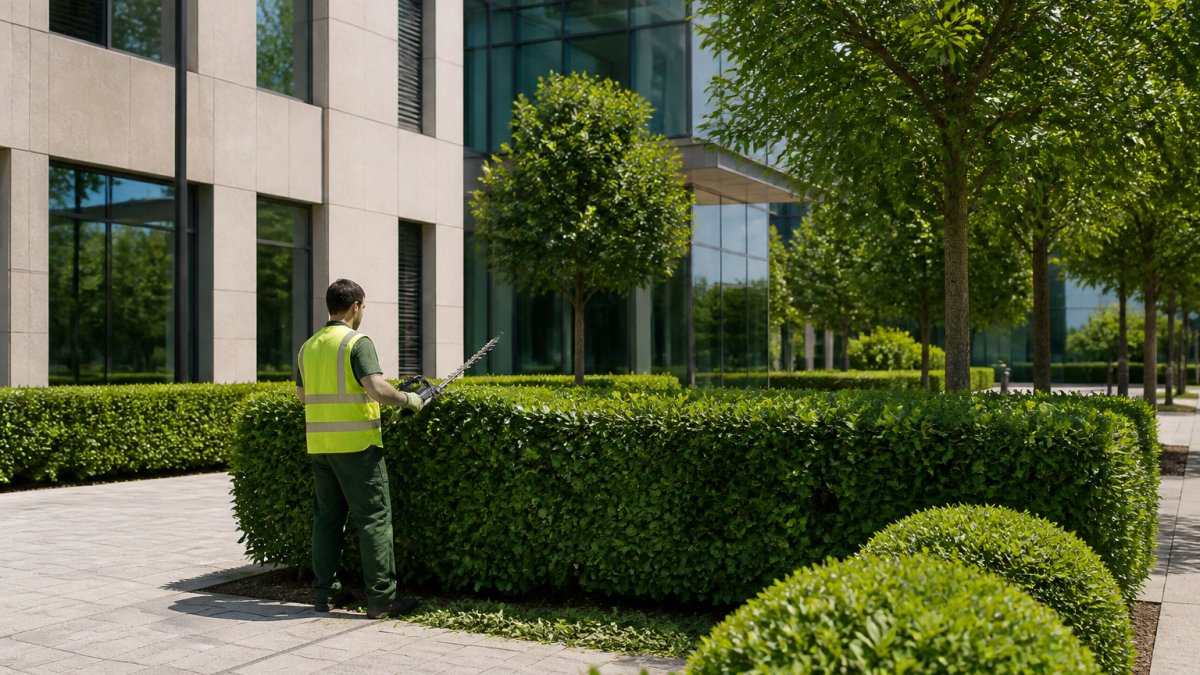
Low-maintenance office landscaping is not the same as cheap landscaping. It means fewer visits, but each visit doing the right work: cutting, edging, weeding, mulching and checking. Ground-cover planting, gravel mulches, dense shrub blocks and simple hedge lines all reduce hours without looking bare.
Watch Out The most common mistake we see is cutting maintenance visits to save money while keeping high-input planting. The beds fail within a season, replacement costs exceed the saving, and the site looks worse than before. Match the planting to the maintenance budget, not the other way round.
This is where reliability matters more than any design flourish. A tailored schedule, with the car park swept before client meetings and seasonal planting in the beds that visitors actually see, beats a generic contract every time.
6. Outdoor Rooms and Functional Outdoor Spaces for Staff and Visitors
Outdoor rooms turn leftover grass into functional outdoor spaces: a bench under a tree, a sheltered table, a planted threshold at reception. Shade, shelter, seating and a reason to step outside are the whole specification.
Start with the route. Accessibility belongs in this trend, not as an afterthought. Paths need to be firm, level and at least wide enough for a wheelchair or a mobility scooter to pass a person walking the other way, a common specification is 1.5 metres minimum clear width on main routes, with passing places on narrower ones.
Seating is the next specification decision. Benches with arms and back support are easier to rise from than backless benches, and a mix of fixed and movable seating lets people choose between a quiet corner and a table where a small meeting can happen. Provide shade, a tree canopy, a pergola or a sail, because a bench in full sun is only usable for part of the day.
Sensory engagement is where biophilic design earns its name. Plant for sound (grasses that move and rustle), scent (lavender, rosemary, honeysuckle near seating), and touch (soft-leaved plants at waist height along a path). Leave seed heads and stems standing through winter so there is something to see and hear when the site is otherwise bare. These are low-cost moves that make the space feel alive rather than merely tidy.
The wellbeing case is best made in qualified, practical terms rather than overclaimed wellness language. A common pattern on commercial sites is that staff who have a comfortable, accessible place to step outside for ten minutes return to work calmer and more focused; the mechanism is straightforward, daylight, fresh air, a change of view and a moment away from the desk.
Finally, design for maintenance. Outdoor rooms fail when the furniture is moved, the planting is trampled, or the route floods. Fix the furniture down or store it sensibly, plant robust species at the edges of routes, and make sure the grounds team can sweep and tidy the space as part of the regular visit.
What This Means for Your Site in 2026
The thread running through all ten trends is the same: planting with a purpose and a maintenance plan attached. Naturalistic planting, native species, water-wise beds, edible borders and outdoor rooms all fail without regular, knowledgeable upkeep. That is the part most site owners underestimate.
Pemigogardens works exclusively with private offices and business parks, on regular maintenance contracts rather than one-off jobs. We bring regular site visits through the year, tailored schedules that fit your meeting calendar, and a team trained in health and safety through Human Focus. Our clients include the Duke of Edinburgh Awards, De Le Cuona, Adair House in Windsor and Comino House in Bourne End, and we are happy to put you in touch with them.
If your grounds need to look considered in every season, tell us about your site and we will walk it with you.
Frequently Asked Questions
What is biophilic landscaping?
Biophilic landscaping is garden and grounds design that deliberately builds a connection to nature into a site. In practice it means layered planting, natural materials, visible seasonal change and spaces people can actually sit in, rather than flat lawns and clipped shrubs. On a commercial site the aim is twofold: grounds that support biodiversity and grounds that give staff and visitors a reason to step outside. It works best when the planting palette, materials and maintenance schedule are planned together from the start, so the nature-connection effect survives year-round upkeep.
How can biophilic design be used in commercial landscaping?
Start with the areas people pass every day: entrances, car park edges and the route to the front door. Swap bare boundaries for layered native planting, add structured beds with sleek edging so the scheme still reads as managed, and put in seating with shade. Water-wise features and rainwater management, such as planted swales, handle drainage while adding habitat. The key is maintenance: a biophilic scheme only holds its look if it is visited on a regular schedule, with seasonal cuts and clearance built into the contract rather than treated as one-off jobs.
Which plants are best for a low-maintenance office landscape?
Choose plants that suit the soil and aspect rather than fighting them. Native and near-native species generally establish faster and need less watering once settled. Grasses, textured perennials and richly coloured planting give seasonal interest without constant deadheading, and structured evergreen hedging keeps visual clarity through winter. Group plants by their water needs so irrigation can be zoned, and mulch beds to hold moisture and suppress weeds. A planting plan built around low-maintenance office landscaping principles will still need seasonal attention, but far fewer visits than annual bedding displays.
How can businesses make their grounds more sustainable?
Four changes do most of the work. First, cut the amount of close-mown lawn and replace it with planted beds or tamer meadow areas. Second, plant for pollinators and biodiversity using native species suited to the site. Third, manage rainwater on site with planted drainage rather than sending it straight to the drains. Fourth, set a maintenance schedule that matches the planting, so beds are cut and cleared at the right time of year. Sustainable landscaping for businesses is mostly about design decisions made once, then protected by a consistent contract.
Grounds that look good in June are easy. Grounds that still look deliberate in January, with the beds intact and the paths clear, take a plan and a team that turns up. That is the work we do. Get started with Pemigogardens and give your office park grounds a maintenance contract built around your site, your calendar and your visitors.
TELL US Submit


Comments