
Is Robotic Landscaping Worth It for Business Parks?
Last Updated: October 29, 2026
Quick Summary
Robotic landscaping is worth it for business parks with large, open, low-obstacle lawns mown frequently, where it cuts mowing labour and raises cut frequency. It struggles on complex, cluttered or publicly accessible sites, so we recommend a hybrid model: an autonomous mower on open lawns backed by a maintenance contract for strimming, edging and clearance.
A robotic mower cuts grass only; it does not sweep, prune, clear leaves or lift litter.
Budget for hardware, installation, power, servicing, insurance and the work the mower cannot do.
Work out payback from your own mowing hours, loaded labour rate and machinery costs, not the purchase price.
Restrict operating hours, geofence away from pedestrian routes and lock the unit overnight.
Define the full maintenance workload first, then decide which part the machine genuinely removes.
Table of Contents
Robotic Landscaping for Business Parks: What Changes on Site
Robotic Mower Cost for Commercial Use: What the Budget Actually Covers
Robotic Mower Return on Investment: Staff Hours, Operating Costs and Payback
Robotic Mowers vs Traditional Landscaping: A Side-by-Side Comparison
The Hybrid Model: Robotic Mowing Alongside a Maintenance Contract
Robotic Landscaping for Business Parks: What Changes on Site
Robotic landscaping is the use of autonomous, self-docking mowers to cut grass on a programmed schedule with minimal manual intervention. For a business park, that changes the maths on grounds maintenance: the question is whether is robotic landscaping worth it for business parks given your site layout, staffing and existing contract. At Pemigogardens, we maintain grounds for private offices and business parks across the M40/M4 corridor, and we're asked this most often by facilities managers weighing a capital purchase against a recurring contract.
Here's the short answer. Robotic mowing suits large, open, low-obstacle lawns mown frequently. It struggles on complex, cluttered or publicly accessible sites. Most business parks sit somewhere in between, which is why the hybrid model usually wins.
Where autonomous mowers fit a business park layout
The technology suits specific ground conditions. A robotic mower needs a defined mowing area, a power source for its docking station, and a surface clear of debris, steep banks and heavy foot traffic during operation.
Business parks often have wide entrance lawns, amenity grassland between buildings, and long verges along access roads, which are the large sections of grass where this type of machine is typically used.
Where it fits less well:
Narrow strips broken up by trees, bollards and lighting columns
Sloping banks and ditches
Areas crossed by pedestrians throughout the day
Beds and borders that need strimming and edging, not mowing
That last point matters more than most guides admit. A robotic mower cuts grass. It does not sweep car parks, prune shrubs, clear leaves or lift litter. Site suitability is about the whole grounds maintenance workload, not just the mowing.
Robotic Mower Cost for Commercial Use: What the Budget Actually Covers
The cost of robotic mowing for commercial use typically includes the machine and docking station, installation, and ongoing maintenance.
Hardware, boundary options and installation vary by model and site, and pricing depends on mowing area, site complexity and the equipment chosen.
Ongoing costs are where budgets often go wrong.
What the budget must cover, in full:
Hardware: the mower, docking station and any boundary wire or virtual boundary kit
Installation: laying boundaries, siting the dock, connecting power
Power: the cost of running the dock year-round
Servicing: blades, batteries and seasonal checks
Insurance and security: cover for equipment left on site overnight
The work it doesn't do: strimming, edging, hedge cutting and clearance still need a maintenance crew or a contract
That final line is where budgets fall apart. A mower that handles routine mowing does not remove the need for grounds maintenance. It reduces the mowing element of it.
For current prices on contracted grounds maintenance, request a quote from Pemigogardens. You can also see our commercial grounds maintenance pricing guide for UK cost benchmarks.
Robotic Mower Return on Investment: Staff Hours, Operating Costs and Payback
Robotic mower return on investment comes down to staff hours and operating costs. The payback period is the point at which saved labour and reduced machinery costs equal the purchase and running costs of the machine. Most guides stop at that definition. Here is a worked example for a typical business park so you can see how the numbers actually stack up.
A worked payback model for a business park
Assume a business park with 8,000 m² of amenity lawn, currently mown weekly through the growing season (say 30 cuts per year) by a ride-on mower operated by one grounds operative.
Now the robotic option. The installed cost of a commercial unit depends on the site and equipment chosen, and annual running costs depend on servicing, power and insurance.
Build the model for your own site in this order and you'll get a defensible answer:
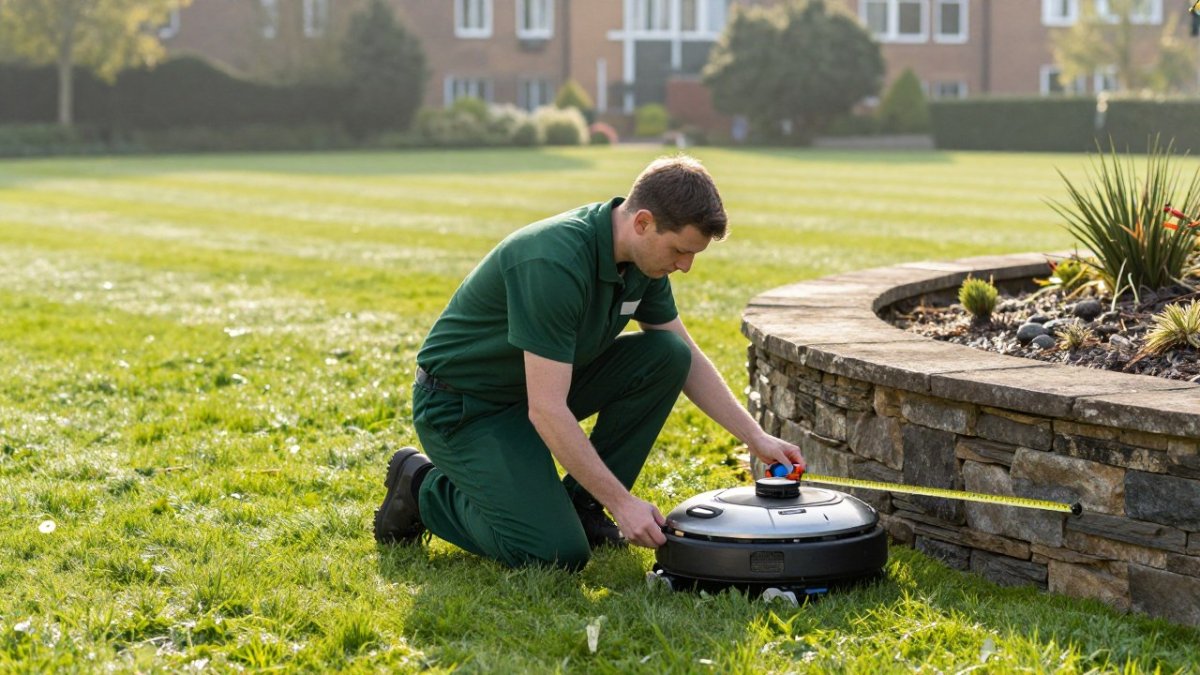
Measure the mowing area in square metres, separately from beds, borders and hard surfaces.
Record current mowing hours per cut, multiplied by mowing frequency across the year.
Apply your loaded labour rate to those hours to get annual mowing labour cost.
Add machinery costs: fuel, servicing, repairs and depreciation on existing equipment.
Total the robotic option: purchase cost, installation, power, servicing and insurance, spread over the machine's working life.
Compare the annual figures, not the headline purchase price.
Stress-test it: what happens if the mower is off site for repair for two weeks in June?
If the annual saving doesn't clear the purchase cost within a period you're comfortable with, the numbers aren't there yet.
To benchmark labour and machinery costs against a contracted service, it helps to see how contractor pricing is structured. For comparison figures on contracted services, request a quote from Pemigogardens.
Cost line | Robotic mowing | Traditional mowing |
Upfront cost | Machine, dock, installation | Existing equipment or contract |
Labour per cut | Minimal once running | Trained employee plus hours |
Fuel and energy | Electricity for dock | Fuel for machinery |
Servicing | Blades, batteries, checks | Full engine and hydraulic servicing |
Frequency achievable | High, often daily | Limited by crew availability |
Work outside mowing | None | Can cover strimming, edging, clearance |
Robotic Mowers vs Traditional Landscaping: A Side-by-Side Comparison
Robotic mowers vs traditional landscaping is not really a like-for-like contest. One is a machine that cuts grass. The other is a service that maintains an entire site.
Robotic mowing wins on: consistency, frequency, quiet operation, reduced labour hours on mowing, and scalability across large open lawns.
Traditional landscaping wins on: everything else. Strimming, edging, hedge cutting, weed control, leaf clearance, litter picking, car park sweeping, seasonal planting and the judgement calls a groundskeeper makes when something looks wrong.
The honest comparison is this: robotic mowing replaces a task, not a service. Buyers who expect a machine to replace their grounds maintenance contractor end up with neat lawns and scruffy edges. That contrast looks worse to visitors than uniformly average grass.
Robotic Mowers for Large Lawns and Multi-Building Sites

Robotic mowers for large lawns can make financial sense, as the labour saving scales with area. A single machine covering a wide amenity lawn removes far more staff hours than one tackling a small courtyard.
Multi-building sites add a practical complication: you need a machine, or a fleet, per mowing area unless the zones connect. Each dock needs power and a sensible location.
This is where scalability cuts both ways. Adding a second mower to cover a new lawn is simple.
Site Suitability, Safety and Liability Before You Buy
Site suitability, safety and liability decide whether a robotic mower is appropriate at all. An autonomous machine cutting unsupervised on a site with public access creates risks that a supervised crew does not.
Start with a simple suitability check:
Is the mowing area clearly defined and free of steep slopes?
Can the dock be sited with power and away from vehicle routes?
Is the area free of public access during operating hours?
Are there trees, bollards or lighting columns breaking up the lawn?
Is the surface clear of debris, stones and fallen branches?
Does the site have somewhere secure to store equipment?
Security, public access and duty of care
Two duties sit alongside each other here. As a site operator you owe a duty of care to anyone on the premises, and you need to show you've assessed the risks of an autonomous machine operating there. Separately, a mower left on site overnight is valuable equipment that needs securing.
Practical measures we'd expect on a commercial site:
Restrict operating hours to times when the area is empty
Set a geofenced mowing area away from pedestrian routes
Lock or immobilise the unit outside working hours
Log faults and incidents, not just fix them
Brief site staff on what to do if the mower stops in an awkward place
For a deeper look at how these duties apply to contracted grounds work, our article on commercial landscaping safety and liability compliance covers the framework.
The Hybrid Model: Robotic Mowing Alongside a Maintenance Contract
The hybrid model is the arrangement we'd recommend for most business parks: an autonomous mower handling routine mowing on the large open lawns, backed by a scheduled maintenance contract covering everything else.
It plays to each side's strength. The machine delivers consistent service and high mowing frequency without tying up staff hours.
It also solves the reliability problem. If the mower is down for repair, the contract crew covers the cut. If the crew is stretched, the lawns still get mown. Neither element carries the whole site alone.
If you're weighing this up, it's worth knowing what a well-drafted agreement should contain before you sign. Our guide to what to include in a grounds maintenance contract walks through scope of work, liability terms and payment conditions.
A common mistake is buying the mower first and treating the contract as an afterthought. Do it the other way round: define the full maintenance workload, then decide which part the machine genuinely removes.
Get a Grounds Maintenance Quote for Your Business Park
The right answer for your site depends on its layout, its lawns and your current arrangement. A machine that suits a wide, open business park lawn may be the wrong call for a site broken up by buildings, trees and pedestrian routes.
At Pemigogardens, we work exclusively with private offices and business parks across the M40/M4 corridor.
We maintain grounds for private offices and business parks, and we can discuss whether robotic mowing is suited to your site alongside a maintenance contract. See our tailored grounds maintenance for business parks to find out what a service built around your site includes.
Frequently Asked Questions
Are robotic mowers suitable for commercial grounds?
They suit open, relatively flat lawns with clear boundaries, which covers much of the amenity grass on a typical business park. They struggle on steep banks, heavily shaded areas and cluttered edges where a strimmer is still needed. Most sites run a mixed approach: robotic mowing for the main lawns and a maintenance crew for beds, hedges, car park edges and seasonal planting.
How much labour can robotic landscaping save?
The saving comes from frequency. A robotic mower cuts little and often, so a crew no longer spends hours each fortnight on routine mowing. That time is freed for planting, tree surgery, clearance and car park sweeping. The exact figure depends on your mowing area, how many obstacles the site has, and whether staff currently travel between buildings to mow.
Can robotic mowers handle large lawns and complex sites?
Commercial-grade models cover large lawns, but a single machine has limits. Large sites usually need several units or a fleet split across zones, each with its own boundary wire or mapped area. Complex sites with multiple buildings, car parks and mixed surfaces need careful zoning and a plan for the areas robots cannot reach.
Are robotic mowers safe around people and wildlife?
Commercial robotic mowers are designed to stop or reverse when they meet an obstacle, and reputable installers fit anti-theft tracking and PIN locking. On a business park with public access, you still need to think about site security, signage and duty of care. Ask any contractor how they handle blades, charging stations and after-hours operation before committing.
If you're weighing up whether autonomous mowing earns its place on your site, the answer usually sits in the numbers and the layout, not the brochure. Pemigogardens can assess your grounds, set out what a tailored maintenance contract covers, and help you decide where a machine fits and where it doesn't. Get started with Pemigogardens and build a grounds maintenance plan around how your business park actually works.
Comments