
Benefits of Professional Landscaping for Office Property Value
Table of Contents
Why Commercial Landscaping Benefits Office Property Value
Curb Appeal and First Impressions That Stick
Time Savings and Reduced Management Effort
How Landscaping and Property Value Connect in Practice
What Appraisers and Surveyors Actually Look At
Office Landscaping Ideas That Improve Tenant Appeal
Why This Matters at Lease Renewal, Not Just at Viewing
What to Avoid
Low-Maintenance Landscaping for Offices: Climate-Resilient Choices
Calculating Return on Investment and Lifecycle Costs
Accessibility, Safety, and Inclusive Site Design
The Design Mechanisms That Actually Matter
Why This Connects to Property Value
Choosing a Professional Landscaping Partner for Your Office
Frequently Asked Questions
Last Updated: October 6, 2026
Why Commercial Landscaping Benefits Office Property Value
Professional landscaping for office property value starts with one uncomfortable fact: most owners treat grounds as a cost line, not a capital decision. This guide from Pemigogardens examines commercial landscaping benefits for private office owners across the M40/M4 corridor, separating what genuinely moves office property value from what merely looks tidy in a brochure.
Two things drive the effect: kerb appeal and first impressions, which shape how a building is read before anyone steps inside, and time savings and reduced management effort, because a site that maintains itself predictably costs less to run and presents better all year.
Curb Appeal and First Impressions That Stick
Curb appeal is the visual quality of a site as seen from the road, car park and entrance, and for offices it is the first filter in how a business is judged.
What most guides miss is that first impressions for commercial property are not about flower beds but consistency.
For facilities managers, this reframes the job: you are not buying mowing, but a predictable presentation standard that holds up on the day a prospective tenant arrives unannounced.
Time Savings and Reduced Management Effort
Time savings from a professional contract come from removing the coordination overhead around the mowing, not the mowing itself.
When grounds are handled ad hoc, someone internally absorbs the scheduling, chasing, site inductions, waste removal and complaints after a wet week. That invisible cost moves off your team with a regular contract.
One point of contact for all grounds work, including tree surgery, cleaning and clearance
Fixed visit schedule, so site access and client-facing days can be planned around it
Health and safety training held by the contractor, reducing your induction burden
Pro Tip If your site has client meeting days, build the visit schedule around them rather than the other way around. Thursday visits before Friday client days, for example, keep the site at its best when it matters most.
How Landscaping and Property Value Connect in Practice
Landscaping and property value connect through comparable evidence and tenant behaviour, not a fixed uplift formula. Be sceptical of any provider quoting a single percentage.
First, lettability: better-presented sites attract more enquiries and let faster at a given rent. Second, rent resilience: tenants renew where the workplace experience is good, and grounds are part of that.
That is the honest return on investment story: cumulative and site-specific, not a one-off uplift applied to a valuation.
What Appraisers and Surveyors Actually Look At
Surveyors assess the whole property, and landscaping feeds into condition, presentation and market positioning rather than appearing as a separate line. A well-kept site supports the argument that the asset is well managed, which matters when a valuer compares your building against others on the same estate.
Poorly designed landscaping reads as a maintenance liability, and liabilities get priced in. Aim for a scheme that looks deliberate and is cheap to hold, not one that looks expensive and is expensive to keep.
Watch Out Skipping a proper maintenance plan is the most common way landscaping spend gets wasted. A scheme installed without a clear ongoing programme typically degrades within a couple of seasons, and the site ends up looking worse than if nothing had been done.
Office Landscaping Ideas That Improve Tenant Appeal
Office landscaping ideas that improve tenant appeal share one trait: they support how people actually use the site and give a leasing agent something concrete to sell. Outdoor seating, clear pedestrian routes, structured planting and well-lit car park edges do more for tenant satisfaction than ornamental beds nobody walks past.
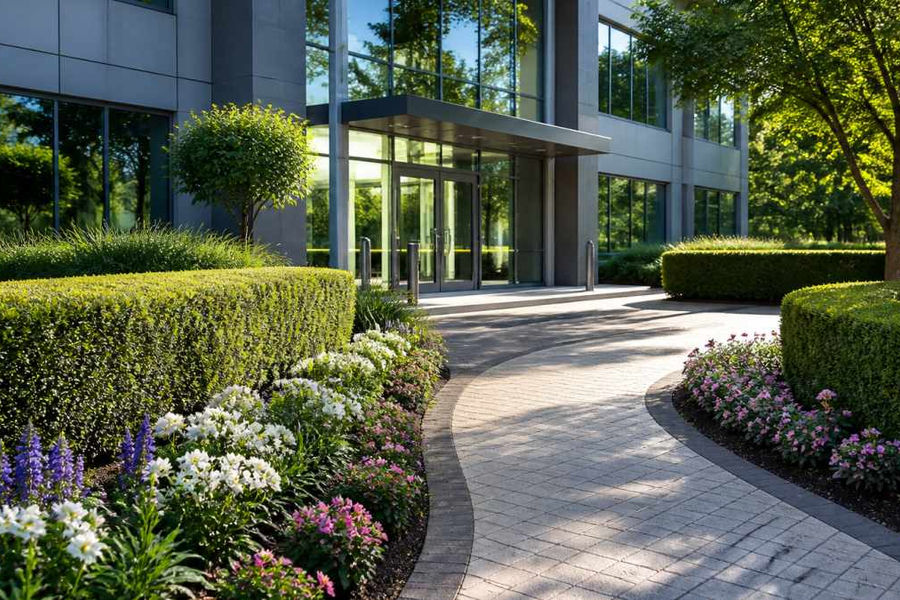
The strongest options for private offices tend to be:
Structured boundary planting for privacy and a defined site edge
Outdoor amenity space with seating, used at lunch and between meetings
Car park greening that breaks up hard surfacing without blocking sightlines
Why This Matters at Lease Renewal, Not Just at Viewing
The leasing argument is where most guides stop, and where the real value sits. A tenant deciding whether to renew weighs relocation cost, fit-out disruption and commuting patterns against the workplace they already have.
First, usable outdoor space extends the effective floor area without extending the footprint.
Second, presentation consistency reduces the friction of tenant complaints.
Third, outdoor amenity supports the workplace-experience narrative occupiers use to justify office attendance.
Pro Tip If you are preparing a vacant suite for viewings, time the grounds programme so the site is at its peak for the viewing window, not the week after. A tenant's first impression of the building is formed in the car park, before they meet the agent.
What to Avoid
Not every landscaping idea helps leasing. The ones that tend to backfire are:
Dense planting that blocks sightlines from reception or between car park and entrance, which reads as a security concern to occupiers with lone workers or late finishes
Water features with high running costs, which become a maintenance liability and a noise complaint risk
Ornamental bedding schemes that look tired for half the year and need constant replacement
The test is simple: does the feature make the site easier to use, cheaper to hold, or more attractive to a specific tenant profile you are targeting? If it does none of those, it is decoration, not an asset.
Low-Maintenance Landscaping for Offices: Climate-Resilient Choices
Low-maintenance landscaping for offices means designing for the site's actual conditions so the scheme needs less intervention to keep looking right: right plant, right place, and species that cope with drier summers and wetter winters.
What most guides get wrong is treating low maintenance as "plant it and forget it." Nothing on a commercial site is truly zero-maintenance.
Choose drought-tolerant planting for exposed, south-facing beds
Use mulch and ground cover to suppress weeds and hold moisture
Keep grass areas simple and shaped for efficient mowing
A climate-resilient scheme also protects your budget: fewer replacements, fewer emergency call-outs and less watering mean a lower lifecycle cost, the number that matters over a five or ten year hold.
Calculating Return on Investment and Lifecycle Costs
Return on investment on grounds work should be calculated over the life of the scheme, not the first season. The useful model is total cost of ownership: installation, annual maintenance, replacement planting, and the cost of the site underperforming.
Use this structure to build a defensible business case:
Cost or benefit | What to include | How to measure it |
Installation | Design, planting, hard landscaping, irrigation if used | One-off capital figure |
Annual maintenance | Scheduled visits, seasonal work, tree surgery, clearance | Fixed annual contract value |
Replacement and repair | Plant losses, surface repairs, storm damage | Historic average per year |
Lettability | Time to let, enquiry volume, rent achieved | Compare against similar local stock |
Tenant retention | Renewal rate, reasons given at renewal | Exit and renewal feedback |
Operating effort | Internal hours spent coordinating grounds | Hours per month, costed |
The comparison that matters is not "professional versus nothing" but "planned programme versus reactive spend." Reactive budgets tend to be higher and produce a worse-looking site, because everything is urgent and nothing is scheduled.
Key Takeaway Judge a grounds contract on lifecycle cost and presentation consistency, not on the headline annual figure. The cheapest quote usually reflects a thinner programme, not a better deal.
Accessibility, Safety, and Inclusive Site Design
Accessible and safe grounds are a legal and practical requirement, and a value issue. A site that is hard to move around, poorly lit or uneven will be raised at lease renewal, sometimes as a formal defect.
The UK framework that matters here is the Equality Act 2010, which places a duty on service providers and employers to make reasonable adjustments for disabled people, including physical access to premises.
The Design Mechanisms That Actually Matter
Accessibility on a commercial site is not a single feature but a set of connected decisions, and getting one wrong can undermine the rest.
Pathways should be firm, even and wide enough for wheelchairs and mobility aids, with dropped kerbs at crossing points. A common failure is a route that is wide enough at the entrance but narrows at a pinch point near a planting bed.
Surfaces should be slip-resistant and free-draining. Block paving that settles and pools after rain is a trip hazard and a complaint generator.
Lighting should cover pedestrian routes and car park edges, not just the building entrance. Lux levels should be consistent along the route so there are no dark gaps between fittings.
The guidance from the Health and Safety Executive on workplace safety is a sensible reference point for how outdoor areas should be assessed and maintained. Routine inspection of trees, surfaces and lighting is part of the job, not an add-on, and it should be documented so you can evidence it if asked.
Why This Connects to Property Value
Inclusive design is not just a compliance cost. It affects who can use the building, and therefore who will lease it.
A genuinely accessible site is more attractive to occupiers with public-facing functions, employers with an ageing workforce, and tenants with diversity and inclusion commitments they report on. It also reduces the risk of a discrimination claim arising from the physical environment, a liability that sits with the occupier and can reach back to the landlord through the lease.
Watch Out Accessibility is often treated as a one-off design exercise at fit-out. In practice, planting growth, surface settlement and lighting failures degrade access over time. A site that was compliant on day one can drift out of compliance within a few seasons if no one is checking.
For inclusive design, the principle is straightforward: everyone who uses the site, employees, visitors and contractors, should be able to move through it comfortably, with clear routes from car park to entrance, rest points on longer approaches, and surfaces that drain properly rather than pooling after rain. The practical test is to walk the route yourself, at night, in the rain, and ask whether you would want to do it with a mobility aid or a pushchair.
Choosing a Professional Landscaping Partner for Your Office
Choosing a partner comes down to reliability and fit, not the longest list of services.
We would apply the same test.
Ask for references from comparable private office sites, not generic commercial work
Confirm who holds health and safety training and how it is evidenced
Check how variations and extra works are priced and approved
On price, expect a genuine difference between quotes. A higher figure usually reflects more visits, trained staff and proper equipment. Pricing depends on site size, specification and frequency, so ask for a written scope and a quote rather than comparing headline numbers.
Grounds that look managed do not happen by accident, and they do not stay that way without a programme behind them. Pemigogardens provides regular site visits, tailored grounds maintenance, and a comprehensive service covering tree surgery, cleaning and clearance, delivered by a team trained in health and safety.
Frequently Asked Questions
Can professional landscaping increase the value of an office property?
Yes, but the effect is indirect and varies by site. Landscaping influences office property value through tenant appeal, reduced void periods, and lower ongoing maintenance costs rather than a fixed percentage uplift. Surveyors and appraisers look at site appearance, condition, and how well the grounds support the building's use. A planned programme of professional landscaping, with regular visits and quality workmanship, supports those factors more reliably than a one-off tidy-up.
How does office landscaping affect tenant appeal and retention?
Tenants notice outdoor spaces daily, from the car park to the entrance. Well-planned landscaping, including greenery, seating, and clear pathways, creates a better first impression for visitors and staff. That matters at lease renewal, when occupiers weigh up competing office property. Reliable landscape maintenance also reduces complaints about overgrown areas or blocked sightlines, which keeps facilities managers focused on the building rather than chasing contractors.
Which landscaping improvements offer the best value for commercial properties?
Prioritise the areas tenants and visitors see most: entrances, car parks, and boundary planting. Upgrading these with low-maintenance landscaping for offices, such as hardy shrubs, structured hedging, and durable hard surfaces, delivers visible improvement without high ongoing costs. Tree surgery, seasonal planting, and regular clearance also protect the site from safety issues. Discuss priorities with your grounds maintenance provider so the plan matches your site's footfall and budget.
How do we know a landscaping contractor will show up consistently?
Ask for references from similar private office or business park sites and check whether the contract includes scheduled visits across the year, not just reactive call-outs. A provider that works directly with private clients, rather than through managing agents, is easier to hold to account. Confirm who will actually attend site, whether the same team returns each visit, and what happens if a scheduled date is missed. Get the visit frequency and scope in writing before signing.
TELL US Submit



Comments