
How to Choose Grounds Maintenance Technology for Offices
Last Updated: October 31, 2026
Quick Summary
Grounds maintenance technology for offices is the equipment, software and automated systems used to keep outdoor areas safe, tidy and presentable year-round. Match it to the tightest constraint on site, such as narrow gates and pedestrian routes, not the largest lawn, and favour the smallest, quietest, most controllable tools that still deliver a consistent finish.
Most office sites spend more time on edges, beds and clearing than on mowing, so budget accordingly.
Battery-powered equipment is generally quieter than petrol engines and produces no exhaust emissions at the point of use.
Robotic mowers suit open, level lawns with a power source nearby and a defined boundary.
Build payback as a three-year comparison of capital cost, consumables, servicing and labour hours.
A technology-ready contract specifies which machines are used and where they are stored and charged.
Table of Contents
Why Office Grounds Need Different Technology to Business Parks
Grounds Maintenance Equipment Comparison: Matching Kit to Site Size and Landscape
Electric Grounds Maintenance Equipment: What It Changes for an Office Site
Robotic Lawn Mowers for Commercial Grounds: Where They Work and Where They Don't
How Grounds Maintenance Software Keeps Schedules, Work Orders and Invoicing in One Place
Total Cost of Ownership and Payback on Grounds Maintenance Technology
Safety, Accessibility and Privacy: The Office-Specific Checks
Planning a Technology-Ready Maintenance Contract for Your Office
Why Office Grounds Need Different Technology to Business Parks
Office grounds maintenance technology is the equipment, software and automated systems used to keep the outdoor areas of a workplace safe, tidy and presentable year-round. Pemigogardens works exclusively on private offices and business parks, and the distinction matters more than most facilities managers expect. An office site is judged on the view from the reception window and the walk from the car park to the front door, not on hectares of open amenity grass. That changes what you buy. A business park can justify wide-area mowing kit; an office with 0.4 hectares, a formal entrance bed and 60 parking bays usually cannot. The right grounds maintenance technology for offices is the smallest, quietest, most controllable set of tools that still delivers a consistent finish on the days that matter.
Grounds Maintenance Equipment Comparison: Matching Kit to Site Size and Landscape
The practical rule is simple: match equipment to the tightest constraint on site, not the largest lawn. Narrow gates, kerbed islands, mature trees and pedestrian routes decide which machines are viable long before budget does.
Site profile | Core equipment | Why it fits | Watch out for |
Under 0.5 ha, formal planting | Pedestrian mower, battery strimmer, backpack blower | Precise edges, low noise near windows | Slow on long runs of grass |
0.5-2 ha with car parks | Ride-on mower, sweeper attachment, hedge cutter | Covers open lawns and bays efficiently | Storage and charging space needed |
2 ha+ with mixed landscape | Out-front rotary, utility vehicle, trailer | Fast coverage, moves kit and arisings | Access width and turning circles |
Heavy tree cover or slopes | Tracked or self-propelled units | Stability and grip | Higher maintenance burden |
A common mistake is buying for the biggest single task. In practice, most office sites spend more time on edges, beds and clearing than on mowing, so budget accordingly.
Electric Grounds Maintenance Equipment: What It Changes for an Office Site
Electric grounds maintenance equipment changes three things that matter to an office: noise, fumes and where you can work. Battery-powered mowers, strimmers, hedge cutters and blowers are generally quieter than petrol engines and produce no exhaust emissions at the point of use. That makes early-morning visits before client meetings far easier to schedule. The trade-off is planning. Every machine needs a charging point, spare batteries and a rotation that keeps a full set ready, so a lockable store with power is now part of the specification, not an afterthought. Where a site has no external power, larger battery banks or a small generator are the usual answer.
Robotic Lawn Mowers for Commercial Grounds: Where They Work and Where They Don't

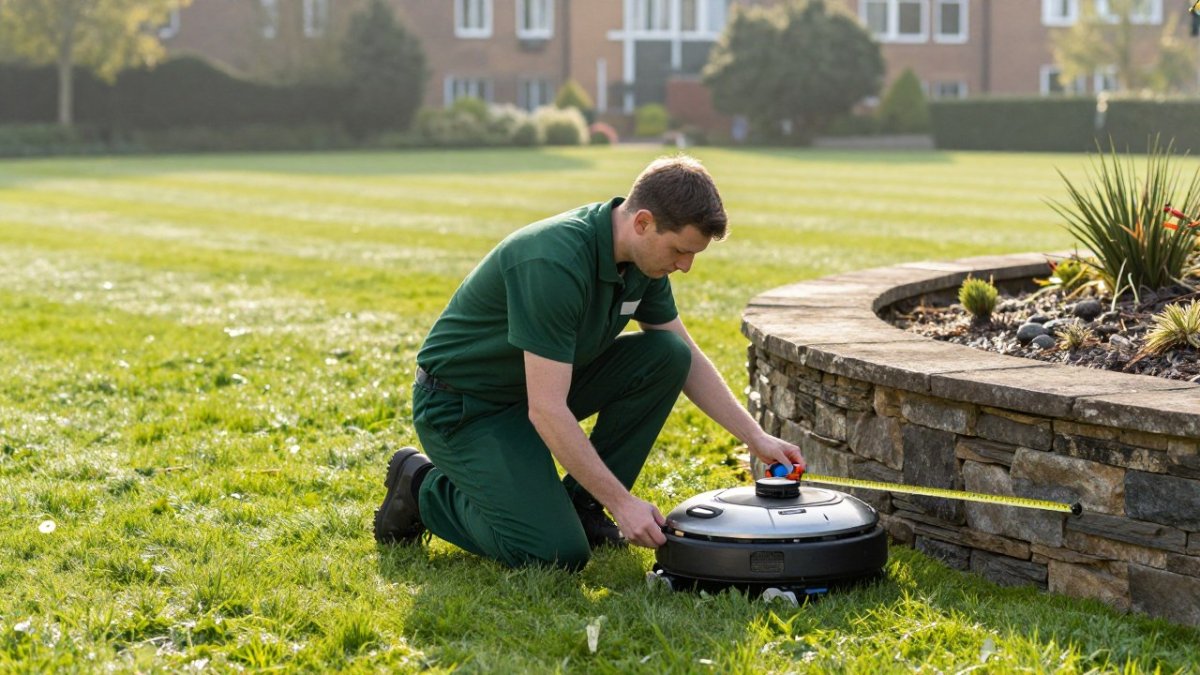
Robotic lawn mowers for commercial grounds are generally suited to open, level lawns with a power source nearby and a defined boundary. They are generally a poor fit where the lawn is broken up by beds, trees and kerbs, where pedestrians cross the grass constantly, or where the ground is uneven. Security is the other consideration: a machine left out overnight needs to be visible from the building and covered by site access rules.
For an office site, the decision usually comes down to three practical questions: how the boundary is defined, how the machine is charged and stored, and how it is managed across a fleet. Boundary options generally include buried perimeter wire, which is reliable but disruptive to install, and GPS or camera-based systems, which avoid the wire but can struggle under tree canopy or close to buildings.
Charging and storage are a practical consideration for any robotic installation, since each machine needs a power supply and a suitable place to dock.
Fleet management is where office sites differ most from domestic installations, since multiple machines across a business park need a schedule, a fault log and a plan for when one is offline.
Where robots do not fit, the reasons are usually access, terrain or risk. Steep banks, narrow gates, gravel paths and heavily used pedestrian routes all argue against automation.
Key Takeaway Robotic mowing pays back on open, level lawns with a reliable power source and a clear boundary. On fragmented, heavily used or uneven office grounds, the labour saving rarely materialises, and a battery pedestrian mower is the more dependable choice.
How Grounds Maintenance Software Keeps Schedules, Work Orders and Invoicing in One Place
Grounds maintenance software is generally used as a scheduling and record-keeping layer that ties visits, tasks and billing together. For an office, its value is typically a dated record of work carried out, by whom and when.
Total Cost of Ownership and Payback on Grounds Maintenance Technology
Total cost of ownership is the purchase price plus batteries, charging, servicing, storage, downtime and staff training across the equipment's working life. The payback case for an office rarely rests on fuel savings alone. It rests on labour: a machine that finishes a task in half the time, or a robot that removes a weekly mow, releases hours that can be redirected to entrance planting, litter picking and car park presentation. Before committing, ask for a simple three-year comparison of capital cost, consumables, servicing and labour hours for the current method versus the proposed one.
The first step is to separate one-off costs from recurring ones. One-off costs include the machine itself, any charging infrastructure (an external power point, a lockable store with power, or a larger battery bank), boundary wire installation for robots, and initial staff training. Recurring costs include consumables (blades, line, batteries), servicing, insurance, software subscriptions, and the labour hours to operate and manage the equipment.
The purchase price is often a smaller part of the three-year picture than people expect. Batteries are the item most often underestimated: a commercial battery pack may need replacement within the equipment's life, and the cost of a spare set can be a meaningful fraction of the machine price. Charging infrastructure is the second: a lockable store with power is now part of the specification, and retrofitting power to a compound without it can cost more than the equipment it serves.
The payback case is best built as a three-year comparison of the current method against the proposed one, using your own site's hours rather than headline rates. For each task, list the current labour hours, the proposed labour hours, the consumables and servicing for each, and the capital cost of the new equipment. The difference in labour hours, multiplied by your loaded hourly rate, is the annual saving; the capital and one-off costs divided by that saving gives a simple payback period. If the period is longer than the equipment's expected life, or longer than your contract term, the technology is a preference, not an investment.
Watch Out Do not accept a payback case built on fuel savings alone. On most office sites the labour released by faster or autonomous equipment is the dominant number, and a case that ignores it will understate the return; a case that overstates it will not survive the first year of operation.
Two further office-specific costs are easy to miss. The first is downtime: a machine out of service during a client visit week is a presentation risk, so the contract should specify response times and backup arrangements. The second is staff training and change management: operatives used to petrol equipment need time to adapt to battery rotation and robot management, and that time has a cost. Both belong in the three-year comparison, not in a footnote.
Safety, Accessibility and Privacy: The Office-Specific Checks
Safety, accessibility and privacy are where office grounds differ most from open landscape work. Pedestrian routes, accessible parking bays, dropped kerbs and building fire exits all constrain where machines can operate and when. Machinery near a public entrance needs a banksman or a cordoned zone, and cutting near glazing or vehicles carries risk that open parkland does not. Privacy matters too: a grounds team working outside meeting rooms and windows should follow a site protocol on timing, sightlines and photography, particularly if images are being captured for work-order records. It is worth having a written method for each area, not a verbal briefing. For a deeper look at the standards involved, our guide to office grounds maintenance safety standards sets out the checks in full, and if you want a structured way to formalise them, our guide to commercial grounds risk assessments shows how to record and review them.
Planning a Technology-Ready Maintenance Contract for Your Office
A technology-ready contract specifies the equipment and systems, not just the tasks. Set out which machines will be used and where they will be stored and charged, how work orders will be raised and closed, what records you will receive, and what happens when a machine is out of service. Agree visit days around your client meetings, and put response times and reporting in writing. Pricing depends on site size, frequency and specification, so ask for a quote against your actual site rather than a headline rate. Before you negotiate, read our guidance on negotiating a commercial landscaping service contract and managing commercial landscaping SLAs so the technology commitments are enforceable. It also pays to vet your contractor properly before signing anything.
The test of any grounds maintenance technology is whether your site looks right on the morning of a client meeting. At Pemigogardens, we build our contracts around regular site visits throughout the year, services tailored to your specific site, and reliable, consistent upkeep covering mowing, car park sweeping, tree surgery, cleaning and clearance. We work directly with private offices and business parks across the M40/M4 corridor. Get started with Pemigogardens and put your grounds on a schedule you can rely on.
Frequently Asked Questions
What technology is used in grounds maintenance?
Grounds maintenance technology covers four main areas: battery-powered mowers, strimmers and blowers; robotic mowers that cut lawns on a set schedule; software that handles task scheduling, work orders and invoicing; and asset tracking for equipment. For an office site, the useful combination is usually electric hand tools for noise-sensitive areas, a robotic mower on the main lawn, and a simple scheduling system so visit dates and tasks are agreed in advance rather than phoned in.
How can robotic mowers help maintain office grounds?
Robotic lawn mowers for commercial grounds are generally designed to cut little and often, which keeps the lawn tidy between visits. They run quietly, so they suit sites where client meetings or nearby offices rule out a petrol mower at 8am. They need a defined boundary, a power source for charging and a lawn without steep banks or heavy leaf fall. They handle the lawn, not the car park sweeping, hedges or beds.
Can electric grounds maintenance equipment reduce emissions?
Yes. Battery-powered mowers, strimmers and blowers produce no exhaust emissions on site, which matters where grounds sit next to office windows, air intakes or car park walkways. The gains move to the charging point rather than disappearing entirely, so ask how the batteries are charged and whether the contractor uses a mains supply or a generator. Electric kit also cuts noise, which is often the bigger practical benefit on an office site with staff working nearby.
What should businesses consider when choosing grounds maintenance technology?
Start with the site, not the catalogue. Map lawn area, slopes, bed count, car park size and any areas with restricted access, then match equipment to those. Check noise limits around meeting rooms, whether charging is possible, and how the contractor records visits and reports issues. Ask for a grounds maintenance equipment comparison in writing, including what happens when a machine breaks down. Finally, confirm the technology is backed by a fixed visit schedule, because kit alone does not keep grounds tidy.
Comments