
Why Office Grounds Maintenance Matters in 2026: A Guide
Table of Contents
Why Office Grounds Maintenance Matters More Than Ever in 2026
How Commercial Grounds Maintenance Cost 2026 Is Shaped by Scope and Risk
What Actually Sits Inside a 2026 Price
Why the Cheapest Quote Often Costs the Most
The Cost-Benefit Case You Can Put in Front of a Finance Director
Grounds Maintenance Health and Safety Compliance: Your Legal Duties on Site
The Site Risk Assessment and Method Statement You Should Expect
Sustainable Grounds Maintenance Practices That Cut Long-Term Costs
Biodiversity Net Gain Is a Maintenance Obligation, Not a Planting Exercise
Feeding Grounds Data into Carbon and ESG Reporting
Year-Round Care: Winter Gritting, Weather-Responsive Maintenance and Site Accessibility
From Cost Line to Strategic Asset: Curb Appeal, Wellbeing and Biodiversity Net Gain
Choosing and Managing a Grounds Maintenance Contract in 2026
Conclusion
Frequently Asked Questions
Last Updated: October 1, 2026
Why Office Grounds Maintenance Matters More Than Ever in 2026
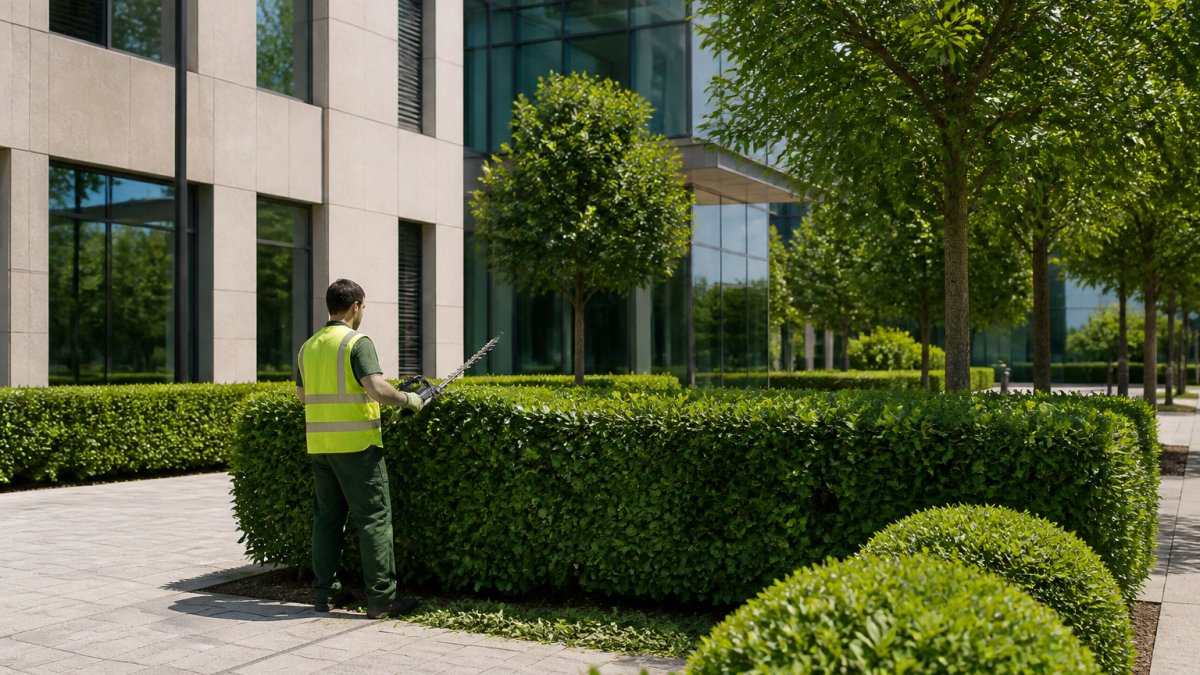
Office grounds maintenance is the scheduled care of the outdoor areas around a commercial building: lawns, hedges, car parks, pathways and seasonal planting. It is no longer cosmetic, it is the first thing a client sees and increasingly part of your environmental reporting.
At Pemigogardens, we work exclusively with private offices and business parks across the M40, M4 and Thames Valley corridor. A prospective client forms an opinion before they reach reception: kerbs thick with weeds, faded line markings and overflowing beds tell a story, and rarely the one you want told.

Three things have shifted the calculation for 2026. First, the Environment Act 2021 has made biodiversity net gain a live planning condition for many developments, with maintenance obligations running for decades. Second, energy and labour costs have pushed reactive work above the cost of a planned contract. Third, outdoor space is now part of the package people weigh up when deciding where to work.
The sites that look effortless are almost never maintained reactively. Below, we break down what your legal duties are, and how to choose a contractor who turns up.
How Commercial Grounds Maintenance Cost 2026 Is Shaped by Scope and Risk
Commercial grounds maintenance cost in 2026 is driven by four variables: site size, visit frequency, specification level and access risk. There is no meaningful "average price per square metre" because two identical-sized sites can differ enormously in how long the work takes. Any contractor quoting from a postcode and acreage alone is guessing, and you will pay for the guess later.
The spec decides the price far more than the acreage. A simple cut-and-clear on a flat, open site is quick; the same area with steep banks, overhanging trees or beds needing seasonal colour takes two to three times as long per visit. A single access gate that must be unlocked, coned and marshalled adds labour before a mower starts.
Visit frequency is the second lever. A fortnightly growing-season contract with monthly winter visits costs more than a monthly year-round schedule, but it prevents the catch-up work that inflates reactive bills. Once a site needs two visits to recover from one missed cycle, the planned contract is almost always cheaper.
What Actually Sits Inside a 2026 Price
Labour is the largest single component and the one that has moved most. Wage pressure across horticulture has pushed up the cost of every visit, and contractors who have not repriced since 2023 are either absorbing losses or cutting corners you cannot see. Fuel, machinery, insurance and waste transfer make up most of the rest.
Read a quote by asking for it broken down by task and frequency rather than a single annual figure.
Why the Cheapest Quote Often Costs the Most
Low quotes are usually low because something has been left out, most commonly waste removal, strimming around obstacles and winter gritting. When those reappear as extras, the annual total climbs past the quote you rejected.
Watch Out A quote that excludes green waste removal is not a cheaper quote. It is a quote for a service you will end up paying for twice, once to the contractor and once to a waste carrier.
The Cost-Benefit Case You Can Put in Front of a Finance Director
Grounds maintenance is usually defended on aesthetics, the weakest argument in a budget meeting. The stronger case is risk and retention: a planned contract removes unpredictable reactive spend, reduces the likelihood of a slip or trip claim, and supports the outdoor space staff and visitors actually use.
Key Takeaway Ask every tenderer for a task-by-task breakdown, a written list of exclusions, and the annual cost of the reactive work their planned schedule is designed to prevent. That single comparison exposes most of the gap between the cheapest and the best quote.
Grounds Maintenance Health and Safety Compliance: Your Legal Duties on Site
Grounds maintenance health and safety compliance means meeting your duties under the Health and Safety at Work etc. Act 1974 and the Management of Health and Safety at Work Regulations 1999. As site owner or occupier you carry the primary duty of care, even when a contractor does the work.
Current public and employers' liability insurance certificates on file
Written risk assessments for the specific tasks and your site
Method statements covering machinery, working at height and lone working
Evidence of training for chainsaw, strimmer and mower operators
A named supervisor you can contact during works
Accident reporting procedure that feeds back to you
The Site Risk Assessment and Method Statement You Should Expect
A site risk assessment identifies what could cause harm on your specific grounds: traffic movement in the car park, uneven paving, overhead power lines near trees, public access routes. A method statement sets out how the work will be done safely.
Sustainable Grounds Maintenance Practices That Cut Long-Term Costs
Sustainable grounds maintenance practices reduce long-term cost by cutting waste, fuel and replacement planting. The measures that pay back fastest are usually the least glamorous.
Biodiversity Net Gain Is a Maintenance Obligation, Not a Planting Exercise
This is the part of sustainability that catches facilities managers out, and it is where most maintenance guides stop short. Under the Environment Act 2021, many developments must deliver a measurable biodiversity net gain, and that gain has to be secured and maintained for a set period, commonly 30 years. The guidance on biodiversity net gain from the government sets out how the duty applies and what it requires.
Feeding Grounds Data into Carbon and ESG Reporting
Facilities managers are increasingly asked to report on the environmental performance of the whole estate, and grounds maintenance is usually the last area brought into that reporting. The reason is simple: the data is not captured at the point of work.
Pro Tip Ask prospective contractors to show you a sample monthly report from another site. If it lists visits completed but no fuel, waste or habitat data, it will not support your reporting obligations.
Key Takeaway On a site with a biodiversity net gain condition, the maintenance specification and the habitat management plan are the same document. Treat them separately at your peril.
Year-Round Care: Winter Gritting, Weather-Responsive Maintenance and Site Accessibility
Winter gritting is the most important weather-responsive service on a commercial site, because it is the one most likely to generate a claim. If someone slips on ice in your car park and you had no gritting arrangement, the question of whether you did enough will be asked.
Pro Tip Ask your contractor for the gritting trigger threshold in writing, and for the time window between mobilisation and completion. "We grit when it's icy" is not a specification you can hold anyone to.
From Cost Line to Strategic Asset: Curb Appeal, Wellbeing and Biodiversity Net Gain
Curb appeal is the commercial argument for grounds maintenance, and it is measurable in a way people forget: your grounds are the setting for every client visit, recruitment interview and photograph taken on site.
Choosing and Managing a Grounds Maintenance Contract in 2026
A grounds maintenance contract should specify what is done, how often, to what standard, and what happens when it is not. Vague contracts are why so many facilities managers end up managing the contractor instead of the grounds.
Build the contract around these elements:
A schedule of works listing every task by area, with frequency for growing season and winter separately.
Service level agreements that define an acceptable standard, not just a task list. "Edges cut" means little without a tolerance.
A named team with a commitment that the same operatives attend your site.
Reporting on visits completed, works carried out and any defects spotted.
A review point at least twice a year to adjust the schedule to how the site actually behaves.
Conclusion
The hard part is not finding someone to cut the grass. It is finding a contractor who turns up on the agreed day, works to a written specification, and gives you the paperwork to prove your site is compliant. Get that wrong and you spend the year chasing, explaining and re-tendering.
Tell us about your site.
Frequently Asked Questions
What specific services are included in professional office grounds maintenance?
A professional contract typically covers grass cutting, hedge and shrub trimming, seasonal planting, car park sweeping, litter clearance, weed control, and tree surgery. Hard landscaping such as paths and kerbs sits alongside soft landscaping like lawns and borders. In winter, gritting and snow clearance keep routes safe. Reputable providers agree a service level agreement with you, so visits happen on set days, such as Thursdays before client meetings, and every task is documented.
How does well-maintained landscaping impact employee productivity and wellbeing?
Views of greenery and well-kept outdoor space give staff somewhere to take breaks away from their desks, which supports concentration and mood. Biophilic design research links access to nature with lower stress and better focus, although the size of the effect varies by workplace. For facilities managers, the practical gain is a site people are happy to arrive at, and outdoor areas that actually get used rather than ignored.
What are the legal responsibilities of business owners regarding site safety and grounds maintenance?
Under the Health and Safety at Work etc. Act 1974 and the Management of Health and Safety at Work Regulations 1999, you must keep the site, including external areas, safe for staff and visitors. That means managing risks such as uneven paving, overgrown sightlines, and ice in winter. Contractors should provide risk assessments and method statements, and hold relevant training. Ask to see these documents before work starts, and keep them on file.
Why is sustainable site management becoming a priority for office parks in 2026?
Sustainability now affects both running costs and reporting. Biodiversity net gain requirements under the Environment Act 2021 mean new developments must deliver a measurable gain in habitat, which flows into how grounds are managed. At the same time, facilities managers face questions about carbon footprint from mowing, gritting and waste. Practices such as robotic mowers, reduced chemical use, and green roof maintenance cut emissions while keeping the site presentable, making sustainability a practical decision rather than a slogan.
TELL US Submit


Comments