
Car Park Maintenance Service Requirements: A 2026 Guide
Updated: Sep 16
Table of Contents
Understanding Your Car Park Maintenance Service Obligations
Condition Surveys and Structural Appraisals
Implementing a Planned Preventative Maintenance Schedule for Car Parks
Surface repairs and pothole remediation
Drainage systems and water management
Line marking and signage compliance
Car Park Line Marking Standards and Regulatory Compliance
Conducting a Car Park Risk Assessment Template
Health and Safety Requirements for Your Commercial Site
Seasonal Maintenance and Winter Readiness
Building a Sustainable Maintenance Programme
Last Updated: August 11, 2026
Understanding Your Car Park Maintenance Service Obligations
Your commercial car park is the first impression clients get of your business, a critical safety asset, and a significant financial investment. Yet most facility managers approach car park maintenance reactively, fixing problems only after they become visible or dangerous.
Car park maintenance service requirements aren't optional extras, they're legal obligations backed by building control regulations, health and safety law, and environmental standards. Failing to meet them exposes your business to liability, regulatory penalties, and costly emergency repairs that could have been prevented.
At Pemigogardens, we've worked with private office complexes and business parks across the Thames Valley for years. A small crack in asphalt becomes a pothole. Blocked drainage systems cause flooding. Worn line markings create confusion and safety hazards. What starts as a £500 repair becomes a £5,000 replacement.
This guide walks you through the specific car park maintenance service requirements your commercial site must meet: condition surveys, structural appraisals, drainage systems, line marking standards, and seasonal readiness. We'll show you how to build a preventative maintenance programme that keeps costs down, extends surface life, and maintains compliance.
Key Takeaway The difference between a well-maintained car park and a liability-prone one comes down to planned preventative maintenance. Reactive repairs are always more expensive and disruptive than planned ones.
Condition Surveys and Structural Appraisals
A condition survey is your baseline. It documents exactly what you're working with and what needs attention first.
For most commercial car parks, conduct a formal condition survey every 2-3 years, with a detailed structural appraisal for multi-storey facilities every 5 years. The survey documents surface defects (cracks, potholes, spalling concrete), drainage performance, line marking condition, and safety hazards. A structural appraisal assesses load-bearing capacity, waterproofing integrity, and structural stability, critical for multi-storey car parks where failure carries serious safety consequences.
A condition survey establishes a baseline against which you can measure deterioration. If you've documented minor cracking in 2024 and your 2026 survey shows significant expansion, you know that section needs priority attention.

The survey should be carried out by a qualified surveyor or engineer with car park assessment experience. They'll produce a detailed report with photographs, measurements, and recommendations prioritised by urgency and cost.
Pro Tip Request a condition survey report that includes a defect register with GPS coordinates or section references. This lets you track specific problem areas over time and measure the impact of your maintenance interventions.
Implementing a Planned Preventative Maintenance Schedule for Car Parks
Planned preventative maintenance keeps costs down and safety high by scheduling work in advance based on asset condition and seasonal factors.
A planned preventative maintenance schedule for car parks covers four main areas: surface repairs, drainage, line marking, and seasonal treatments. Document the schedule in writing, assign specific dates or seasons, and review annually based on condition survey findings.
Surface repairs and pothole remediation
Potholes form when water penetrates asphalt, freezes, expands, and breaks the surface. Small cracks (under 5mm) can be sealed with crack sealant, a low-cost intervention that prevents water ingress. Larger cracks and potholes require patching with hot-mix asphalt or cold-patch materials. For extensive damage affecting more than 20% of the surface, partial or full resurfacing becomes more cost-effective than patching.
Schedule crack sealing in spring and autumn when temperatures are moderate. Schedule pothole repairs as they're identified, with a target response time of 2-4 weeks for safety-critical locations and 4-8 weeks for minor defects.
Drainage systems and water management
Blocked drains accelerate car park deterioration. Water that should flow away sits on the asphalt, penetrating through cracks and weakening the base. In winter, it freezes and expands, accelerating deterioration.
Inspect drainage channels, gullies, and pipe runs quarterly, more frequently in autumn when leaf debris is heavy. Clear blockages immediately and ensure water flows freely toward drainage points.
Line marking and signage compliance
Worn line markings create confusion and safety risks. Disabled parking spaces, pedestrian routes, and directional arrows must be clearly visible. Line markings should be refreshed every 3-5 years depending on traffic volume and UV exposure.
Use thermoplastic materials that conform to BS EN 1436 for durability. Ensure disabled bays are clearly marked and comply with current accessibility standards. Schedule line marking refreshes every 4 years as standard, or sooner if markings are fading.
Maintenance Task | Frequency | Priority | Estimated Duration |
Crack sealing | Spring, autumn | Medium | 1-2 weeks |
Pothole repair | As identified | High | 2-8 weeks |
Drainage inspection | Quarterly | High | 1 day |
Drainage clearing | As needed | High | 1-3 days |
Line marking refresh | Every 4 years | Medium | 2-5 days |
Condition survey | Every 2-3 years | Medium | 1-2 weeks |
Structural appraisal | Every 5 years | Medium | 2-4 weeks |
Watch Out Ignoring drainage problems is the fastest way to expensive repairs. A blocked drain that costs £200 to clear today becomes a £5,000 surface replacement in two years if water damage spreads.
Car Park Line Marking Standards and Regulatory Compliance
Line markings are safety infrastructure governed by standards that ensure consistency and visibility across commercial sites.
In the UK, car park line markings must comply with BS EN 1436, the European standard for road marking materials and performance. This standard specifies durability, slip resistance, retroreflectivity, and colour consistency.
Disabled parking spaces must meet specific requirements: a minimum 3.6m width for the bay itself, plus a 1.2m access aisle marked with diagonal hatching. The International Symbol of Accessibility (the blue wheelchair symbol) must be clearly visible.
Pedestrian routes through the car park should be clearly marked, especially where they cross vehicle circulation areas. Use contrasting colours and ensure markings are visible in low-light conditions. Directional arrows and signage help manage traffic flow and reduce confusion. One-way systems should be clearly marked with arrows. Speed limit signs and hazard warnings must be installed at appropriate locations.
Thermoplastic markings last 7-10 years in normal conditions. Paint-based markings last 2-3 years. Cold-applied thermoplastic lasts 4-6 years. For high-traffic car parks, thermoplastic is usually the most cost-effective option over the long term. Refresh markings every 4 years as standard, or sooner if retroreflectivity drops below acceptable levels.
Conducting a Car Park Risk Assessment Template
A risk assessment identifies hazards, evaluates the likelihood and severity of harm, and specifies control measures. For car parks, this covers slip and trip hazards, vehicle movement risks, lighting and visibility issues, and structural defects.
Use a structured template to ensure consistency. Your assessment should cover:
Surface hazards: Potholes, cracks, loose asphalt, trip hazards at kerbs or drainage covers
Drainage: Standing water, blocked gullies, flooding in low-lying areas
Lighting: Dark areas, failed lights, glare or reflection issues
Line markings and signage: Faded markings, missing or damaged signs
Vehicle movement: Blind spots, narrow aisles, pedestrian crossing points
Structural integrity: Cracks in concrete, spalling, water ingress in multi-storey structures
Environmental: Fuel or oil spills, chemical storage, waste management
For each hazard, assess the likelihood (unlikely, possible, likely) and severity (minor, significant, major). Multiply these to get a risk rating. High-risk hazards need immediate control measures. Medium-risk items need action within 1-3 months. Low-risk items should be monitored but don't require urgent action.
Document your assessment in writing, including who conducted it, the date, and specific recommendations. Review and update it annually or after any incident or significant change to the site.
Pro Tip Include photographs with your risk assessment. A photo of a pothole with a date stamp is far more compelling evidence than a written description if you ever need to demonstrate that you identified and addressed a hazard.
Health and Safety Requirements for Your Commercial Site
Your car park is a workplace under the Health and Safety at Work etc. Act 1974. You have a legal duty to ensure, so far as reasonably practicable, the health and safety of anyone who uses it: employees, clients, visitors, and contractors.
This means:
Maintaining safe surfaces: Potholes, cracks, and loose asphalt are trip and fall hazards. Repair them promptly.
Managing water and drainage: Puddles create slip hazards and damage surfaces. Keep drains clear and surfaces well-drained.
Providing adequate lighting: Dark areas increase accident risk and create security concerns. Install and maintain lighting to appropriate standards.
Controlling vehicle movement: Use one-way systems, speed limits, and clear markings to reduce collision risk. Separate pedestrian routes from vehicle circulation where possible.
Managing hazardous substances: If fuel, oil, or chemicals are stored on site, ensure proper containment and labelling.
Maintaining structural integrity: In multi-storey car parks, structural defects can lead to collapse. Regular inspections and prompt repairs are essential.
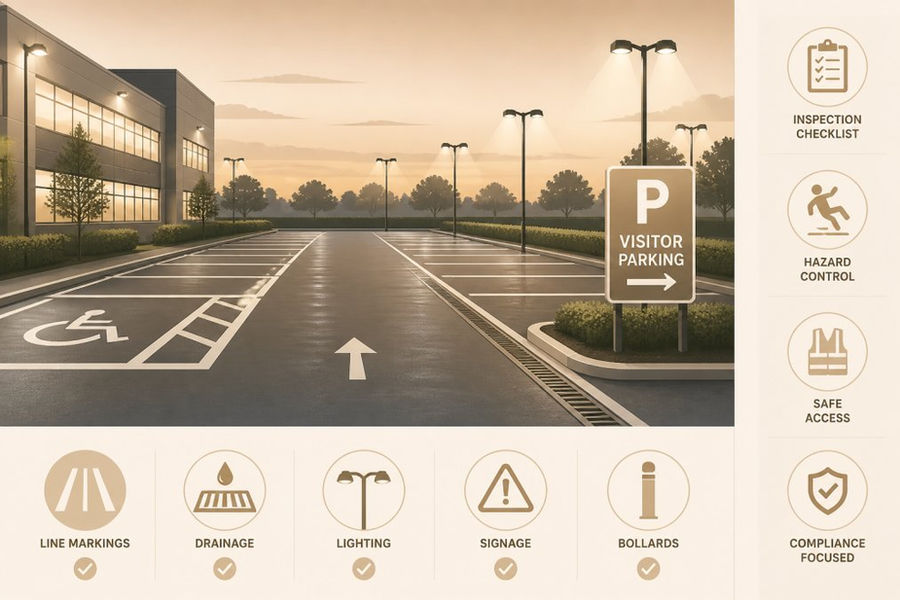
Conduct regular inspections, at least quarterly, to identify emerging hazards. Document these inspections and any actions taken. Consider appointing someone responsible for car park safety who understands the risks and has authority to arrange repairs or improvements.
Seasonal Maintenance and Winter Readiness
Seasonal changes bring different maintenance challenges. Winter is the most demanding season, when frost, ice, and snow accelerate deterioration and create safety hazards.
Autumn preparation: Clear leaves and debris from drains to prevent blockages. Inspect and repair any damage from summer use. Apply surface treatments if needed before winter weather arrives. Check that gritting equipment is serviced and ready.
Winter management: Grit or salt car parks as soon as ice forms to prevent slips. Clear snow and ice promptly after each fall. Inspect surfaces regularly for frost damage and potholes. Keep drains clear of snow and ice to allow water to flow away.
Spring recovery: Clear up salt residue and debris. Repair any frost damage to surfaces. Refresh line markings if winter wear has faded them.
Summer maintenance: Monitor surface condition in hot weather, as asphalt can soften and rut under heavy loads. Keep drains clear and functioning. Maintain lighting systems. Plan any major repairs or resurfacing for quieter periods.
Building a Sustainable Maintenance Programme
A sustainable maintenance programme balances cost, safety, and environmental impact over the long term. It's not just about fixing problems, it's about making decisions that reduce overall resource use and environmental harm.
Lifecycle planning means thinking beyond the immediate repair. When a pothole appears, you could patch it cheaply, or assess whether the whole section is reaching end-of-life. A lifecycle cost analysis, comparing the total cost of ownership over 10-20 years, shows that planned resurfacing often costs less than repeated patching.
Permeable surfacing is increasingly relevant for environmental compliance. Traditional asphalt and concrete shed water rapidly, increasing flood risk. Permeable materials allow water to drain through the surface, reducing runoff and improving drainage. They cost more upfront but reduce the need for extensive drainage infrastructure.
Energy efficiency in lighting has improved dramatically. LED conversion of car park lighting reduces energy use by 50-70% compared to older systems, with payback periods of 3-5 years.
Waste management during maintenance work matters. Asphalt and concrete removed during resurfacing can be recycled. Waste oil and fluids should be collected and disposed of properly.
Asset management systems help track maintenance history, costs, and performance. Recording what work was done, when, and at what cost builds a database that informs future decisions. Over time, you'll know which sections of your car park are most prone to failure and can plan interventions accordingly.
A sustainable programme also means consistency and reliability. Working with a single contractor who understands your site and maintains regular contact is more effective than reactive calls to whoever's cheapest. This is why Pemigogardens works exclusively with private office and business park clients on regular maintenance contracts, consistency matters, and understanding your specific site needs is essential to delivering reliable service.
Document your maintenance programme in writing. Include the schedule, the standards you're meeting, the person responsible, and how you'll monitor and review performance. Update it annually based on condition surveys and experience.
Your car park is an asset that needs active stewardship, not passive neglect. The maintenance service requirements we've covered, condition surveys, planned preventative maintenance, drainage management, line marking standards, risk assessment, health and safety compliance, seasonal readiness, and sustainable planning, aren't bureaucratic boxes to tick. They're the practical framework that keeps your site safe, compliant, and cost-effective.
The cost of planned maintenance is always lower than the cost of reactive emergency repairs. A well-maintained car park reflects well on your business and reduces liability risk. Start with a condition survey to establish your baseline, then build a scheduled maintenance programme tailored to your specific site. If you're managing a private office or business park in the Thames Valley, Pemigogardens can help implement and deliver that programme. We work exclusively with private clients on regular maintenance contracts, so consistency and reliability are built into how we operate. TELL US Submit to discuss your site's specific needs.
Frequently Asked Questions
What are the legal health and safety requirements for commercial car parks in the UK?
Commercial car park owners must comply with the Occupiers' Liability Act 1957 and the Health and Safety at Work etc. Act 1974. This means maintaining safe conditions, addressing hazards like potholes and poor drainage, ensuring adequate lighting, and providing clear signage. Regular inspections, documented maintenance records, and risk assessments are essential. Your car park maintenance service should include routine defect identification and prompt remediation to meet these legal obligations.
How often should a commercial car park be inspected for defects?
Most industry guidance recommends quarterly inspections as a minimum, with additional checks after severe weather. However, high-traffic car parks may benefit from monthly reviews. Your planned preventative maintenance schedule for car parks should include formal condition surveys at least annually, with documented findings. Regular visual inspections between formal surveys help catch emerging issues like pothole formation, drainage blockages, and line marking wear before they escalate into safety risks or costly repairs.
What does a car park risk assessment template typically cover?
A comprehensive car park risk assessment template should evaluate surface condition (cracks, potholes, spalling), drainage effectiveness, lighting adequacy, line marking visibility and compliance, slip resistance, signage clarity, structural integrity (particularly for multi-storey facilities), and environmental hazards. It should document current defects, assign risk ratings, and prioritise remedial actions. This systematic approach ensures nothing is overlooked and provides evidence of due diligence for insurance and legal purposes.
What car park line marking standards must we follow in the UK?
Line markings must comply with BS EN 1436 (road safety markings standard) and align with guidance in the Traffic Regulation Order if applicable. Markings should be thermoplastic or equivalent durable material, clearly visible in all weather conditions, and use approved colour schemes (typically white or yellow). Disabled bays must meet BS 8300 accessibility standards. Regular refreshing maintains slip resistance and visibility. Proper line marking is both a safety requirement and a legal compliance obligation under health and safety regulations.
TELL US Submit
This article was written using GrandRanker



Comments