
Sustainable Grounds Maintenance for Modern Offices: A 2026 Guide
Table of Contents
Why Sustainable Grounds Maintenance Matters for Modern Offices Environmental Impact and Corporate Social Responsibility Business Benefits Beyond Aesthetics
Environmental Impact and Corporate Social Responsibility
Business Benefits Beyond Aesthetics
Eco-Friendly Commercial Landscaping UK: Core Practices Reducing Chemical Usage and Pesticides Water Conservation Techniques Waste Management and Composting Systems
Reducing Chemical Usage and Pesticides
Water Conservation Techniques
Waste Management and Composting Systems
Biodiversity Net Gain for Commercial UK Properties Supporting Pollinator-Friendly Landscapes Creating Wildlife Corridors on Office Grounds
Supporting Pollinator-Friendly Landscapes
Creating Wildlife Corridors on Office Grounds
Native Plants for Commercial Landscaping UK Best Native Species for Thames Valley and M40 Corridor Low-Maintenance Native Planting for Year-Round Appeal
Best Native Species for Thames Valley and M40 Corridor
Low-Maintenance Native Planting for Year-Round Appeal
Cost of Sustainable Grounds Maintenance UK: ROI and Financial Modelling Long-Term Savings Through Reduced Chemical and Water Spend Calculating Your Carbon Footprint Audit Savings
Long-Term Savings Through Reduced Chemical and Water Spend
Calculating Your Carbon Footprint Audit Savings
Smart Technology Integration in Sustainable Grounds Maintenance IoT Sensors for Water and Resource Monitoring Scheduling and Compliance Tracking Tools
IoT Sensors for Water and Resource Monitoring
Scheduling and Compliance Tracking Tools
Implementing Sustainable Grounds Maintenance: A Step-by-Step Framework Phase 1: Audit Your Current Grounds and Environmental Impact Phase 2: Design Your Bespoke Maintenance Plan Phase 3: Execute and Monitor Progress
Phase 1: Audit Your Current Grounds and Environmental Impact
Phase 2: Design Your Bespoke Maintenance Plan
Phase 3: Execute and Monitor Progress
Common Mistakes to Avoid in Sustainable Grounds Maintenance
Last Updated: July 24, 2026
Why Sustainable Grounds Maintenance Matters for Modern Offices
Sustainable grounds maintenance has become essential for organisations balancing environmental responsibility with professional aesthetics. Companies investing in sustainable grounds maintenance report improved employee wellbeing, enhanced client perceptions, and reduced operational costs. The UK's growing regulatory framework increasingly expects organisations to measure and report environmental impact. What separates effective sustainable grounds maintenance from greenwashing is specificity: successful programmes combine targeted ecological interventions, smart resource management, and transparent monitoring.
Key TakeawaySustainable grounds maintenance transforms your office exterior from a cost centre into a visible demonstration of environmental commitment, with measurable impacts on employee retention, client perception, and regulatory standing.
Environmental Impact and Corporate Social Responsibility
When office grounds transition from monoculture lawns to biodiverse, low-input landscapes, measurable ecological value emerges. Native species provide food sources for pollinators. Reduced chemical runoff protects local waterways. Soil health improves year on year, storing more carbon and requiring less intervention.
For corporate social responsibility reporting, grounds maintenance sits at an intersection few organisations exploit effectively. Your outdoor spaces are visible to clients, employees, and the local community, and auditable in ways many other sustainability initiatives aren't. The Environment Act 2021 introduced mandatory Biodiversity Net Gain (BNG) requirements for developments. Demonstrating proactive biodiversity improvements positions your organisation ahead of future compliance requirements.
Business Benefits Beyond Aesthetics
Many businesses find that sustainable approaches reduce total grounds maintenance costs within 18-24 months. Fewer pesticide applications mean lower chemical expenses and reduced compliance overhead. Native plants, once established, require less water and fewer nutrients than ornamental species. Composting systems turn waste into soil amendments, eliminating disposal costs.
Research indicates that access to green space improves mental health, reduces stress, and increases productivity. When office grounds shift from sterile, chemically-treated landscapes to biodiverse environments, employees notice. This contributes to recruitment and retention metrics, particularly among younger professionals who prioritise environmental values.
Eco-Friendly Commercial Landscaping UK: Core Practices
Eco-friendly commercial landscaping in the UK starts with a fundamental shift in how you approach plant selection, water management, and pest control. Sustainable landscaping works with your local climate, soil conditions, and existing ecosystem to create landscapes that thrive with minimal intervention.

Reducing Chemical Usage and Pesticides
The most immediate step in transitioning to sustainable grounds maintenance is eliminating unnecessary pesticide and herbicide applications. A thorough audit often reveals that 60-70% of routine chemical applications target problems that won't significantly impact your grounds' appearance or function.
Integrated Pest Management (IPM) replaces blanket chemical applications with targeted, evidence-based interventions. This means monitoring pest populations, identifying thresholds at which they warrant action, and deploying the least toxic control method first. For example, many common office landscape pests can be managed through habitat modification, removing standing water, improving soil drainage, or introducing natural predators like beneficial nematodes.
Herbicide reduction follows similar logic. Hand-weeding, mulching, and selective mechanical removal address weeds without chemical residues. For areas where weeds are genuinely problematic, acetic acid-based herbicides or hot-water treatments provide chemical-free alternatives.
Watch OutAbruptly ceasing all chemical applications without a transition plan often results in temporary aesthetic decline and pest outbreaks. Sustainable grounds maintenance requires a phased approach, typically 12-18 months, to allow natural predator populations to establish and soil biology to recover.
Water Conservation Techniques
Water consumption in commercial landscaping often reflects outdated assumptions about what "well-maintained" grounds require. Smart irrigation controllers use weather data, soil moisture sensors, and plant water requirements to deliver precisely what's needed. Drip irrigation and soaker hoses deliver water directly to plant root zones, reducing evaporative losses compared to overhead sprinklers. Rainwater harvesting systems can reduce mains water consumption by 30-50%.
Soil improvement underpins water efficiency. Grounds with high organic matter content retain moisture more effectively. Mulching, applying 5-10cm of organic material around planting beds, reduces evaporative losses whilst improving soil structure and suppressing weeds.
Waste Management and Composting Systems
Commercial grounds generate substantial organic waste: grass clippings, pruned branches, fallen leaves. Sustainable grounds maintenance recycles this material on-site through composting systems. Even modest composting operations can process 80-90% of a property's organic waste. The resulting compost improves soil structure, enhances water retention, and reduces the need for external soil amendments.
Waste reduction starts upstream. Selective pruning minimises material requiring disposal. Leaving some leaf litter in planting beds supports soil biology and wildlife. Grass clippings can be mulched back into lawns, returning nutrients rather than removing them.
Biodiversity Net Gain for Commercial UK Properties
Creating measurable biodiversity improvements on your grounds demonstrates environmental leadership and contributes to your organisation's ESG metrics.
Supporting Pollinator-Friendly Landscapes
Pollinators are essential ecosystem engineers. Many commercial landscapes inadvertently exclude them through monoculture planting, chemical pesticide use, and removal of flowering plants. Pollinator-friendly landscapes feature continuous flowering from spring through autumn, providing nectar and pollen sources throughout the growing season.
Native flowering plants are particularly valuable because they've co-evolved with UK pollinator species. A single native plant species may support 20-30 pollinator species, whereas non-native ornamentals often provide little food value. Designing planting schemes around native species creates landscapes that are simultaneously beautiful and ecologically productive. Avoiding pesticide use is non-negotiable for pollinator support.
Pro TipCreate a small wildflower meadow area (even 50-100 m²) within your office grounds. This single intervention often generates more pollinator activity than scattered planting beds, creating visible ecological benefit that employees and clients immediately notice.
Creating Wildlife Corridors on Office Grounds
Isolated green spaces provide limited ecological value. Wildlife corridors, connected strips of habitat allowing species movement across the landscape, multiply the ecological impact of your grounds maintenance.
For office parks, corridors can be created through strategic planting, retention of existing vegetation, and removal of barriers to movement. Even modest corridors, 2-3 metres wide, provide meaningful habitat connectivity. Water features amplify corridor value. A small pond, rain garden, or shallow depression that collects water seasonally provides drinking water and breeding habitat for amphibians and aquatic insects. Dead wood and leaf litter are crucial habitat for countless species. Retaining fallen branches in designated areas and leaving areas of vegetation unmown creates microhabitats that support beetles, fungi, small mammals, and birds.
Native Plants for Commercial Landscaping UK
Native plant selection represents the foundation of sustainable grounds maintenance. Native species are adapted to UK climate and soil conditions, require minimal inputs once established, and provide maximum ecological value.
Best Native Species for Thames Valley and M40 Corridor
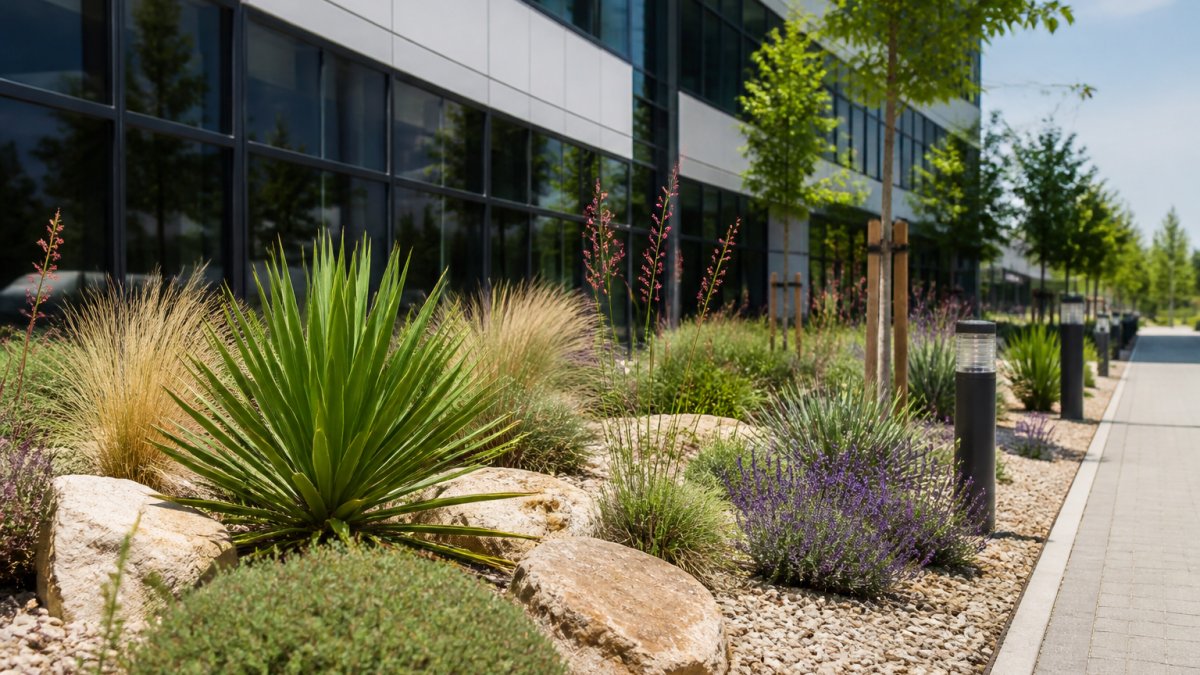
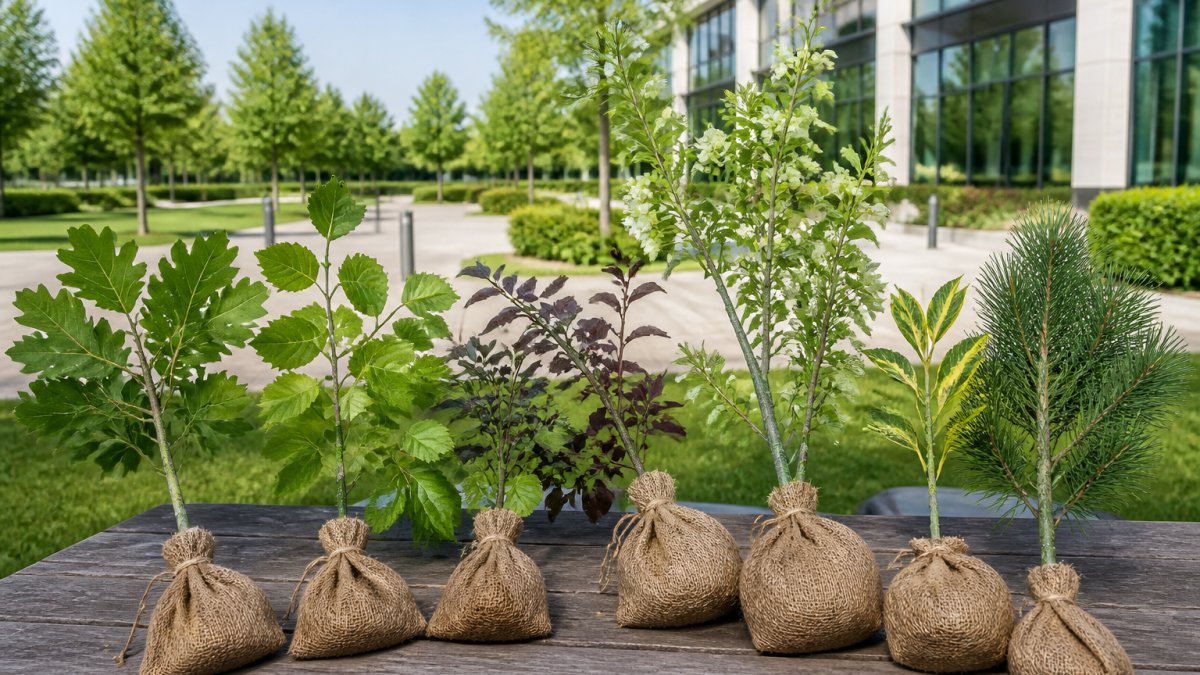
The Thames Valley and M40 corridor occupy a transitional zone between chalk downland, clay plains, and sandstone geology. For chalk soils, native species include bird's-foot trefoil, marjoram, salad burnet, and chalk milkwort. Woody species include hawthorn, blackthorn, and wayfaring tree. For clay soils, moisture-loving natives like devil's-bit scabious, ragged robin, and purple loosestrife thrive. Shrub species include dogwood, guelder rose, and alder. For mixed or improved soils typical of many office parks, ox-eye daisy, teasel, vetch species, and cornflower create meadow-like planting with continuous flowering.
The critical advantage of native species is that they establish reliably without intensive management. Once root systems develop, typically 12-18 months, many native plants outcompete weeds, require minimal water, and sustain themselves with natural nutrient cycling.
Low-Maintenance Native Planting for Year-Round Appeal
Year-round appeal emerges through careful seasonal planning. Spring bulbs provide early colour. Summer sees peak flowering from herbaceous natives. Autumn brings seed heads, grasses, and berries. Winter structure comes from evergreen shrubs and persistent seed heads.
Grass management shifts from weekly mowing to seasonal cutting. Rather than maintaining uniform lawn height year-round, sustainable approaches use different cutting regimes for different areas. Paths receive regular cutting for access. Meadow areas are cut once or twice annually, typically late summer and winter, allowing flowering plants to complete their life cycles. Pruning becomes more selective, focusing on maintaining plant health and structure rather than formal topiary.
Cost of Sustainable Grounds Maintenance UK: ROI and Financial Modelling
Organisations that transition to sustainable approaches typically see reduced total cost of ownership within 18-24 months, with savings accelerating thereafter.
Long-Term Savings Through Reduced Chemical and Water Spend
A typical commercial property spending £3,000-5,000 annually on chemical treatments can expect to eliminate 80-90% of this expense within two years as natural predator populations establish. For larger office parks, annual chemical savings often exceed £10,000.
Water consumption reductions follow a similar trajectory. Properties implementing smart irrigation, mulching, and soil improvement typically reduce water consumption by 30-50% within the first growing season. For Thames Valley properties where water costs average £1.50-2.00 per cubic metre, a 100-hectare office park might reduce annual water spending by £5,000-8,000.
Labour cost analysis is more nuanced. Initial transition may require additional labour for planting native species and installing systems. However, once established, labour requirements typically decrease. Fewer chemical applications, reduced irrigation management, and elimination of intensive weeding create net labour savings. Capital investment in sustainable infrastructure typically achieves payback within 3-5 years through operational savings.
Cost Category | Year 1 | Year 2 | Year 3 | Cumulative Savings |
Chemical reduction | £2,000 | £4,000 | £4,500 | £10,500 |
Water conservation | £2,500 | £4,000 | £4,500 | £11,000 |
Labour optimisation | £1,000 | £3,000 | £4,000 | £8,000 |
Infrastructure amortisation | -£2,000 | -£1,500 | -£1,000 | -£4,500 |
Net Annual Benefit | £3,500 | £9,500 | £12,000 | £24,500 |
Calculating Your Carbon Footprint Audit Savings
Carbon footprint reduction through sustainable grounds maintenance operates through multiple mechanisms. Chemical production and transport carry embedded carbon. Reduced pesticide use eliminates manufacturing impacts. Water conservation directly reduces energy demand for treatment and distribution.
More significantly, healthy soils with high organic matter content sequester carbon. A single hectare of well-managed grassland with native wildflowers can sequester 0.5-1.5 tonnes of carbon annually. For a 2-hectare office park grounds, this represents 1-3 tonnes of annual carbon sequestration, equivalent to removing a car from the road for a year. A typical 2-hectare office park grounds might generate a baseline carbon footprint of 15-25 tonnes CO₂ annually through current maintenance practices. Transition to sustainable grounds maintenance typically reduces this by 40-60%, yielding net sequestration of 5-10 tonnes annually once soil carbon stocks increase.
Smart Technology Integration in Sustainable Grounds Maintenance
Smart systems dramatically improve resource efficiency, reduce waste, and enable data-driven decision-making. Modern grounds maintenance increasingly combines ecological principles with digital tools that optimise outcomes.
IoT Sensors for Water and Resource Monitoring
Internet of Things (IoT) sensors transform grounds maintenance from schedule-based to condition-based models. Soil moisture sensors placed at various depths provide real-time data on water availability. Weather stations measure rainfall, temperature, and humidity, allowing irrigation systems to account for recent precipitation.
For a typical office park, IoT sensor networks cost £2,000-5,000 for installation and initial equipment. Water savings alone typically justify investment within 12-18 months. Nutrient monitoring sensors provide similar value, reducing fertiliser use by 40-60% whilst eliminating excess nutrients that could contaminate groundwater.
Pro TipStart with soil moisture sensors in your most water-intensive areas, planting beds and turf. These provide the quickest ROI and generate data that informs broader smart irrigation strategy.
Scheduling and Compliance Tracking Tools
Sustainable grounds maintenance creates documentation requirements. Digital scheduling platforms consolidate these requirements into unified systems. Cloud-based platforms track maintenance activities, chemical applications, water usage, and resource consumption in real time, creating audit trails for compliance whilst generating data for continuous improvement.
For organisations subject to environmental reporting requirements, these systems provide documentation needed to substantiate sustainability claims. Scheduling tools also optimise labour efficiency by adjusting timing based on actual conditions rather than calendar dates.
Implementing Sustainable Grounds Maintenance: A Step-by-Step Framework
Transitioning to sustainable grounds maintenance requires systematic planning and phased implementation. A structured framework distributes changes across 12-24 months, allowing systems to stabilise and demonstrating progressive improvement.
Phase 1: Audit Your Current Grounds and Environmental Impact
Before implementing changes, understand your starting point. A comprehensive grounds audit documents current practices, costs, and environmental impacts. This baseline enables measurement of progress and calculation of return on investment.
The audit should cover current pesticide and herbicide applications, water consumption and irrigation practices, plant inventory and species composition, soil conditions, waste management practices, labour allocation, and cost breakdown. Soil testing is particularly valuable. A basic soil analysis costs £50-150 per sample and reveals soil health status. Results inform planting selections, fertilisation decisions, and water management strategies.
Phase 2: Design Your Bespoke Maintenance Plan
Armed with audit data, design a customised sustainability plan tailored to your site's conditions, constraints, and objectives. The plan should address phased pesticide reduction, water conservation targets, native planting schemes, waste reduction and composting strategy, biodiversity enhancement targets, labour reallocation, budget and ROI projections, and timeline and milestones.
Prioritisation is critical. Rather than changing everything simultaneously, sequence changes to allow systems to stabilise. Year 1 typically focuses on quick wins: eliminating unnecessary chemical applications, installing smart irrigation controls, beginning native planting. Year 2 builds on these foundations with more substantial changes. The plan should include specific measurables. Professional guidance accelerates planning. Landscape designers experienced in sustainable commercial grounds can identify opportunities and constraints specific to your site.
Phase 3: Execute and Monitor Progress
Implementation requires discipline and patience. Monitoring systems track progress against targets and enable adaptive management.
Monthly monitoring should include chemical application records, water consumption data, waste tracking, labour hours by task type, and visual assessment of plant health. Quarterly reviews compare progress against targets and identify necessary adjustments. Annual comprehensive monitoring includes soil testing and detailed cost analysis.
Phase | Timeline | Key Activities | Expected Outcomes |
Phase 1 | Months 1-2 | Audit, testing, baseline data collection | Documented starting point, cost baseline |
Phase 2 | Months 2-4 | Plan development, stakeholder engagement | Customised sustainability roadmap |
Phase 3 | Months 5-24 | Implementation, monitoring, adjustment | Progressive cost reduction, biodiversity gains |
Phase 4 | Months 24+ | Optimisation, reporting, expansion | Sustained benefits, measurable ESG impact |
Common Mistakes to Avoid in Sustainable Grounds Maintenance
Expecting immediate aesthetic perfection. Sustainable grounds look different from chemically-manicured landscapes. Communicating these aesthetic shifts to employees and clients prevents misinterpretation of transition impacts as maintenance failures.
Eliminating all chemicals simultaneously. Phased reduction allows natural predator populations to establish, preventing population explosions. A typical transition timeline spans 12-18 months.
Neglecting soil improvement. Soils compacted by heavy equipment or depleted of organic matter require amendment before expecting strong plant establishment. Investing in soil improvement in Year 1 prevents Year 2-3 frustration with poor plant performance.
Underestimating water needs during establishment. Newly planted native species require consistent moisture during their first growing season. Smart irrigation systems should be configured generously during establishment, then reduced once plants are rooted.
Inadequate monitoring and data collection. Simple tracking systems enable measurement of success and identify areas requiring adjustment.
Insufficient stakeholder communication. Transparent communication about sustainability objectives, expected timelines, and long-term benefits builds support and prevents misinterpretation of transition impacts.
Sustainable grounds maintenance for modern offices represents a fundamental shift in how organisations approach their outdoor spaces. Rather than viewing grounds as passive aesthetic backdrops requiring intensive chemical and water inputs, sustainable approaches create dynamic environments that deliver environmental, financial, and business benefits simultaneously.
The transition requires patience, planning, and commitment. However, organisations that invest in sustainable grounds maintenance consistently report improved employee wellbeing, enhanced client perceptions, and measurable cost reductions within 18-24 months. Sustainable grounds create visible demonstrations of environmental responsibility that strengthen your organisation's ESG credentials and market positioning.
Pemigogardens specialises in helping private offices and business parks across the Thames Valley and M40 corridor transition to sustainable grounds maintenance. Our team combines landscape expertise with deep understanding of your specific site conditions, enabling customised maintenance plans that deliver genuine environmental impact alongside cost reduction. We work exclusively with property managers seeking reliable, consistent partnerships rather than transactional service providers. UK Environment Act Biodiversity Net Gain Requirements establishes the regulatory framework that increasingly shapes commercial grounds management. Getting ahead of these requirements through proactive sustainable practices positions your organisation as an environmental leader. Contact Pemigogardens to discuss how we can help you design and implement sustainable grounds maintenance tailored to your specific site.
Frequently Asked Questions
What are the key benefits of sustainable grounds maintenance for modern offices?
Sustainable grounds maintenance enhances corporate social responsibility, reduces operational costs through lower chemical and water usage, improves employee wellbeing, and strengthens your company's environmental compliance. It also supports biodiversity and demonstrates commitment to climate resilience, increasingly important for client relationships and ESG reporting.
How much does sustainable grounds maintenance cost for commercial properties in the UK?
Costs vary based on site size, current conditions, and service frequency. Pemigogardens offers tailored maintenance contracts within the M40/M4/Thames Valley Corridor. Initial investment in sustainable practices often offsets through reduced chemical purchases, lower water consumption, and reduced waste management fees over 12-24 months.
What native plants work best for commercial landscaping in the UK?
Native species suited to the Thames Valley and M40 corridor include hawthorn, rowan, oak, and native wildflowers such as bird's-foot trefoil and cornflower. These require less maintenance, support local pollinator populations, and thrive in UK climates. Native planting reduces pest control needs and creates year-round visual interest without chemical intervention.
How does sustainable grounds maintenance contribute to biodiversity net gain?
By reducing chemical usage, installing native plants, creating wildlife corridors, and maintaining soil health, your office grounds become habitat for pollinators, birds, and beneficial insects. This supports local ecosystems and can contribute to biodiversity net gain targets required under UK environmental compliance frameworks, strengthening your corporate environmental impact.
Can you really tailor sustainable grounds maintenance to our specific schedule and needs?
Yes. Pemigogardens works exclusively with private offices and business parks, not managing agents, allowing for bespoke maintenance plans. Whether you need Thursday morning sweeping before client meetings, seasonal planting in specific areas, or custom scheduling, we deliver consistent, reliable service tailored to your site, not standardised routines.
What guarantees do you offer that sustainable grounds maintenance will actually improve our office appearance?
Pemigogardens provides regular site visits throughout the year with health and safety training and excellent references from clients like the Duke of Edinburgh Awards and De Le Cuona. We focus on reliable, consistent upkeep, not quick fixes. Sustainable practices improve soil health and plant vigour, creating visibly better grounds over time with measurable results.
How can I measure the environmental impact and ROI of sustainable grounds maintenance?
Conduct a carbon footprint audit before and after implementation to track emissions reduction. Monitor water consumption, chemical spend, and waste disposal costs. Many offices see 15-30% savings within the first year through reduced inputs. Additionally, document improvements in biodiversity through photo records and employee feedback on outdoor space quality.
This article was written using GrandRanker

Comments