
Eco-Friendly Landscaping Solutions for Office Buildings
Updated: Sep 16
Table of Contents
Why Eco-Friendly Landscaping Solutions for Office Buildings Are a Business Decision
The Core Principles of Sustainable Commercial Grounds Maintenance
Native Planting Schemes for Offices: Choosing the Right Species
Reduce Water Use and Runoff with Smart Irrigation and Permeable Paving
Efficient Irrigation Systems
Permeable Paving and Sustainable Drainage Systems (SuDS)
How to Achieve Biodiversity Net Gain for Business Parks
A Step-by-Step Plan to Retrofit Your Existing Grounds
The Financial and Productivity Case for Eco-Friendly Landscaping
The Cost-Reduction Mechanism
The Productivity and Wellness Evidence
The Certification Angle: BREEAM and the Business Case
Conclusion: Start with a Professional Grounds Audit
Frequently Asked Questions
Last Updated: September 8, 2026
Eco-friendly landscaping solutions for office buildings are no longer a niche environmental gesture; they are a core business decision that affects operational costs, staff retention, and the first impression you make on clients. At Pemigogardens, we maintain commercial grounds across the M40/M4/Thames Valley Corridor.
The commercial case is straightforward: poorly designed grounds generate repeat costs through high water use, constant replanting, and labour-intensive maintenance. Sustainable design reduces these inputs over time.
Why Eco-Friendly Landscaping Solutions for Office Buildings Are a Business Decision
Sustainable landscaping is about reducing long-term operational expenditure and managing environmental risk. For a business park, the landscape is the first and most lasting impression a visitor receives, and a grounds strategy that relies on chemical inputs and excessive irrigation is a liability.
The shift toward green infrastructure is also driven by regulation and expectation. The UK Government guidance on biodiversity net gain now requires new developments to deliver a measurable increase in habitat value, a standard that is beginning to influence how existing sites are managed and reported.
Adopting this approach early positions your property favourably. A site that demonstrates environmental stewardship is easier to let and commands a premium, as tenants increasingly factor sustainability into their property decisions.
The Core Principles of Sustainable Commercial Grounds Maintenance
Sustainable commercial grounds maintenance is the practice of managing outdoor spaces to preserve soil health, reduce water consumption, and support local biodiversity, using inputs only where they are genuinely necessary.

Several principles guide this approach:
Soil health first: Aerate and mulch beds to retain moisture and suppress weeds, reducing the need for watering and chemical controls.
Right plant, right place: Match species to the soil, light, and exposure of each bed to minimise replacement costs.
Reduce hard maintenance: Specify drought-tolerant planting and permeable surfaces that cut down on irrigation and drainage repairs.
Keep organic matter on site: Compost grass clippings and autumn leaves to create a free, natural fertiliser.
A common mistake is treating sustainability as a one-off planting scheme rather than a management regime. The real savings come from a maintenance contract that reinforces these principles through the year.
Native Planting Schemes for Offices: Choosing the Right Species
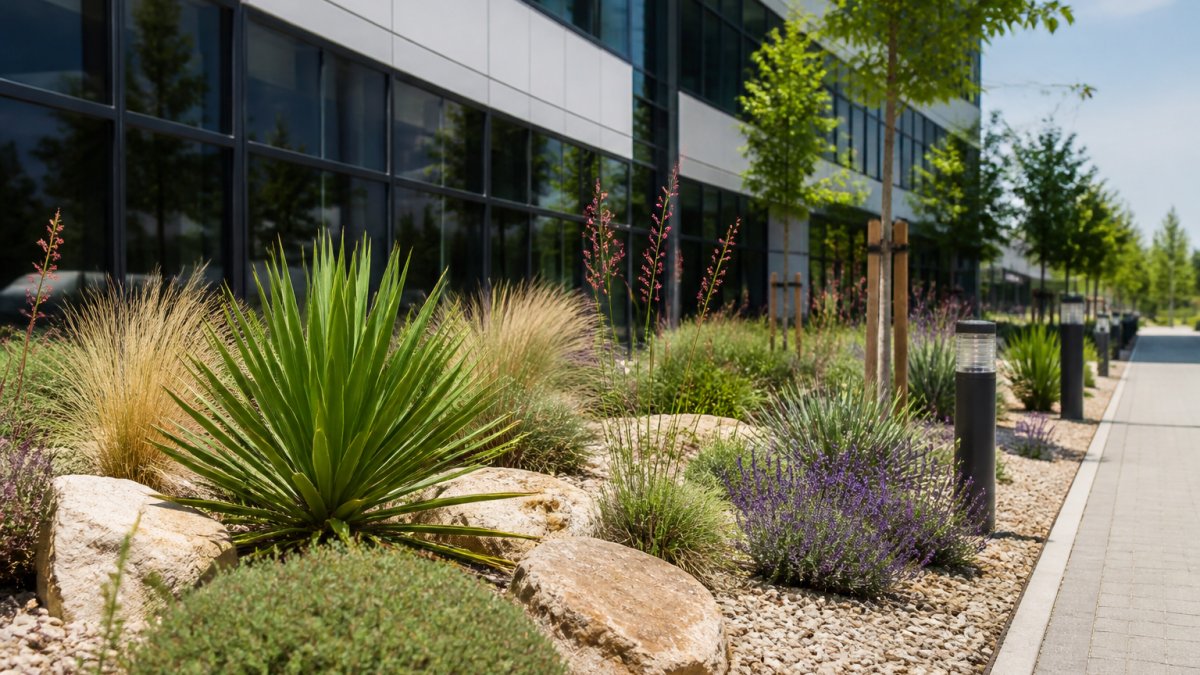
Native plant species are the backbone of an efficient commercial landscape because they are adapted to local rainfall patterns and require minimal intervention once established. For offices in the Thames Valley, this means selecting plants that tolerate the region's clay soils and occasional dry spells.
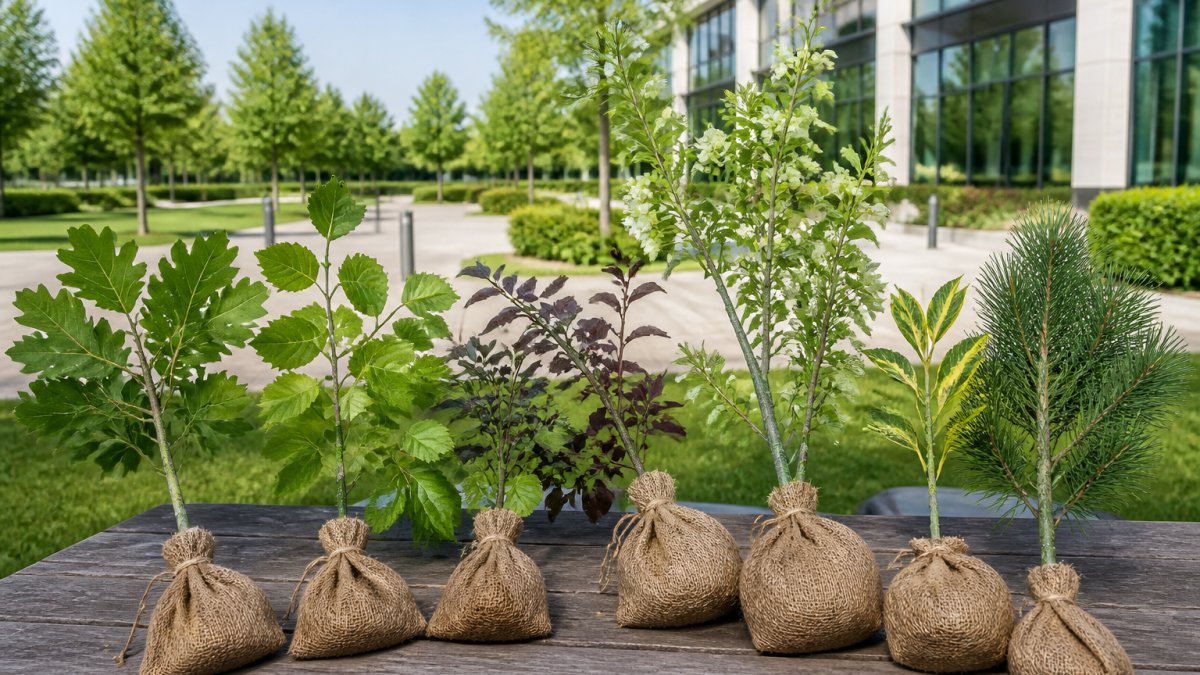
A well-designed native planting scheme for offices should deliver structure and colour across the seasons. Consider a mix of structural shrubs, such as hawthorn and field maple for screening, with lower-level perennials like lavender and salvia for pollinator-friendly ground cover.
Native planting also reduces the urban heat island effect. Trees planted strategically along the south and west elevations of a building provide summer shade, cutting the energy needed for air conditioning.
Reduce Water Use and Runoff with Smart Irrigation and Permeable Paving
Water management is where sustainable design delivers the most immediate return on investment. Reducing reliance on mains water and managing stormwater on site lowers utility bills and prevents costly drainage issues.
Efficient Irrigation Systems
The most effective way to cut water use is to remove the need for irrigation altogether by selecting drought-tolerant species. Where watering is necessary, install a smart irrigation controller that adjusts schedules based on rainfall data and soil moisture levels.
Drip irrigation and soaker hoses deliver water directly to the root zone, reducing evaporation. Grouping plants with similar water needs into distinct zones allows watering only the areas that require it, rather than blanketing the whole site.
A practical pattern for office grounds is to separate the landscape into three hydro-zones:
High-use amenity areas (e.g., entrance beds): These may need occasional irrigation to maintain a polished look.
Transitional zones (e.g., car park borders): Planted with drought-tolerant species that need no irrigation after a two-year establishment period.
Naturalistic zones (e.g., wildflower meadows): These require no irrigation at all once established.
Pro Tip When specifying a smart controller, look for one that supports multiple zones with independent schedules. A single-zone controller is often insufficient for a site with varied planting and exposure.
Permeable Paving and Sustainable Drainage Systems (SuDS)
Permeable paving is a hardscape solution that allows rainwater to filter through the surface into the ground below, rather than running off into storm drains. In the UK, this falls under the remit of Sustainable Drainage Systems (SuDS), which are now a material consideration in many local planning policies.
Options include:
Permeable block paving: Concrete or clay blocks laid with wider-than-usual joints filled with fine aggregate. Suitable for car parks and access roads.
Resin-bound gravel: A porous surface that combines the appearance of gravel with a smooth, accessible finish. Ideal for pathways and terraces.
Reinforced grass grids: Plastic or concrete grids that support vehicle loads while allowing grass to grow through. A good choice for occasional-use overflow parking.
Porous asphalt or concrete: A monolithic surface with a high void content. More common in heavy-duty applications but can be specified for office access roads.
The key mechanism is the construction build-up beneath the surface. A typical system consists of the surface layer, a bedding layer, and a sub-base of open-graded aggregate that stores water temporarily before it infiltrates into the ground or is released slowly into a drainage network.
When planning a car park refurbishment, specifying permeable paving is one of the most effective upgrades available. It manages stormwater at source and can reduce the need for costly attenuation tanks. However, there are trade-offs:
Maintenance: Permeable surfaces require periodic vacuuming or jet washing to prevent clogging from silt and leaf litter. This adds a small but recurring maintenance cost.
Sub-grade conditions: On heavy clay soils, the infiltration rate may be too low for full soakaway design. In such cases, a lined system with a controlled outflow (often called a tanked system) is needed.
Initial cost: Permeable paving typically costs 10-20% more than conventional asphalt or block paving. This premium is often offset by the reduced need for separate drainage infrastructure.
A common pattern on business parks is to combine permeable paving with rain gardens in adjacent planting beds. The paving handles the main vehicle areas, while rain gardens capture runoff from roofs and other impermeable surfaces.
How to Achieve Biodiversity Net Gain for Business Parks
Biodiversity net gain for business parks is the process of leaving the natural habitat in a measurably better state than before the site was developed. For new projects this is now a legal requirement, but for existing sites it can be pursued voluntarily to improve the property's credentials.
The first step is a baseline survey of what is currently living on the site. This identifies areas of poor habitat, such as dense mown grass or bare gravel, which can be converted into wildflower meadows, additional tree planting, or scrub habitat.
Key interventions include:
Creating a wildflower meadow in an underused corner, mown only once a year.
Installing bat and bird boxes on building elevations.
Adding a pond or rain garden to manage water and attract amphibians.
Connecting habitat patches with hedgerows rather than fences.
These measures contribute to ecosystem services, such as pollination and carbon sequestration, which improve the environmental performance of the site.
A Step-by-Step Plan to Retrofit Your Existing Grounds
Retrofitting existing buildings with a sustainable landscape does not require a full redesign. Most sites can be improved incrementally over a single growing season.
Step 1: Conduct a site audit. Walk the grounds and identify problem areas: bare soil, waterlogged patches, and plants that are struggling. These are the zones where inputs are being wasted.
Step 2: Prioritise water management. Address any drainage issues first. Installing a rain garden or permeable surface is the highest-impact change you can make to reduce runoff.
Step 3: Replace high-maintenance plants. As annual bedding plants finish their season, replace them with perennial native species that will return each year without replanting costs.
Step 4: Amend the soil. Apply a mulch layer to beds to suppress weeds and retain moisture, and start a compost heap for green waste.
Step 5: Adjust the maintenance regime. Move to a schedule that reflects the new planting, with less frequent mowing and more targeted weeding in the first two establishment years.
The table below summarises the key actions, their timing, and the expected benefit for a typical office site.
Action | Best Time | Primary Benefit |
Soil audit and mulch | Early spring | Reduces water use, suppresses weeds |
Install smart irrigation | Spring | Cuts mains water consumption |
Replace bedding with natives | Autumn | Eliminates annual replanting costs |
Lay permeable paving | Dry season | Manages stormwater, prevents flooding |
Sow wildflower meadow | Autumn | Boosts biodiversity and pollinator habitat |
The Financial and Productivity Case for Eco-Friendly Landscaping
The financial argument for sustainable landscaping rests on lower maintenance costs and higher asset value. By reducing inputs, the total cost of ownership for the landscape drops year on year, whereas a conventional site requires constant spending to maintain its appearance.
The Cost-Reduction Mechanism
The savings come from specific, measurable reductions in inputs:
Elimination of annual replanting: A conventional office site might spend £2,000-£5,000 per year on seasonal bedding plants that are ripped out and replaced twice annually. A native perennial scheme, once established, has no replanting cost.
Reduced irrigation bills: Mains water for landscape irrigation is metered and charged at commercial rates. Removing irrigation from a site with 1,000 square metres of planted beds can save an estimated 150,000-250,000 litres per year, depending on rainfall.
Lower chemical spend: A healthy, diverse planting scheme with proper soil management requires fewer herbicides and pesticides. This reduces both direct product costs and the labour hours associated with applying them.
Fewer reactive call-outs: A well-planned sustainable site suffers fewer failures, such as plant die-off or drainage blockages, which means fewer emergency call-outs and a more predictable budget.
The Royal Institution of Chartered Surveyors (RICS) publishes guidance on whole-life costing that encourages property owners to evaluate landscape investments over a 25-30 year horizon. Under this framework, a sustainable scheme with higher upfront design costs but lower annual maintenance often outperforms a conventional scheme on net present value.
The Productivity and Wellness Evidence
There is a growing body of evidence linking access to green space with workplace wellness. Staff who can see trees and planting from their desks report lower stress levels, which translates into reduced absenteeism and higher retention.
The Attention Restoration Theory, first proposed by Kaplan and Kaplan in the 1980s, suggests that natural scenes allow the brain's directed attention to recover from fatigue. A view of a well-designed landscape from a workstation can help employees recover cognitive function during short breaks.
For HR and facilities managers, the relevant metrics are:
Absenteeism rates: Some UK-based studies have found that office workers with access to green views take fewer sick days, though exact figures vary by sector and study methodology.
Employee retention: A landscaped outdoor space that can be used for breaks or informal meetings is often cited in employee satisfaction surveys as a valued amenity.
Time-to-fill for vacancies: Properties with high-quality outdoor spaces are often easier to let, and employers report that such amenities help attract candidates in competitive labour markets.
The Certification Angle: BREEAM and the Business Case
In the UK, the most relevant certification for commercial property is BREEAM (Building Research Establishment Environmental Assessment Method). Unlike LEED in the US, BREEAM is the domestic standard widely used by developers and investors.
Landscaping contributes to BREEAM credits in several categories:
Land Use and Ecology: Credits are available for enhancing site ecology, including the use of native species and the creation of new habitat.
Water: Credits are available for reducing potable water consumption, including landscape irrigation.
Management: Credits are available for sustainable maintenance practices, such as the use of organic fertilisers and integrated pest management.
A BREEAM 'Very Good' or 'Excellent' rating is increasingly a prerequisite for letting office space to blue-chip tenants and for securing favourable financing terms from lenders. A landscape strategy that supports these credits is an investment in the lettability and valuation of the asset.
Key Takeaway For facilities managers, the key metric is the reduction in reactive maintenance. A well-planned sustainable site suffers fewer failures, such as plant die-off or drainage blockages, which means fewer emergency call-outs and a more predictable budget. This is the core of the business case: predictability and resilience.
To build a credible business case, document your current landscape spend for 12 months before making changes. This baseline data, covering water, plants, chemicals, and labour, gives you a concrete comparison point when presenting the case to your finance director.
Conclusion: Start with a Professional Grounds Audit
The path to a sustainable landscape begins with understanding what you currently have. A professional audit identifies where money is being wasted and where changes will deliver the fastest return.
At Pemigogardens, we provide tailored grounds maintenance services for private offices and business parks across the M40/M4/Thames Valley Corridor. Our team, trained in health and safety, can assess your site and develop a maintenance plan that incorporates native planting, water efficiency, and biodiversity improvements.
Get started with Pemigogardens and request a grounds audit to see how eco-friendly landscaping solutions can reduce your costs and improve your site.
Frequently Asked Questions
What are the benefits of sustainable landscaping for commercial properties?
Sustainable landscaping lowers water bills, reduces long-term maintenance costs, and improves the visual appeal of your property. It also supports biodiversity and helps with stormwater management. For office buildings, these measures contribute to a healthier environment for staff and create a positive impression for clients, which can support your wider business goals.
How can office buildings improve biodiversity in their grounds?
You can improve biodiversity by replacing monoculture lawns with native planting schemes for offices. Choose a mix of flowering plants and shrubs that provide food and shelter for pollinators. Adding features like log piles, bird boxes, and a small pond offers further habitats. These steps contribute to biodiversity net gain for business parks and create a more interesting landscape.
How does eco-friendly landscaping impact BREEAM ratings?
Eco-friendly landscaping directly supports BREEAM credits in categories like Land Use and Ecology, Water, and Pollution. Measures such as native planting, permeable paving, and efficient irrigation demonstrate a commitment to environmental best practice. Achieving a higher BREEAM rating can increase your property's market value and appeal to environmentally conscious tenants.
How can sustainable grounds maintenance reduce water consumption?
Sustainable maintenance cuts water use by improving soil health with composting and mulching, which helps the ground retain moisture. Switching to drought-tolerant native plants removes the need for constant watering. Modern irrigation systems with moisture sensors water only when needed, while permeable paving allows rainwater to soak into the ground instead of running off.
TELL US Submit

Comments