
Sustainable Site Management: A 2026 Beginner's Guide
Updated: Sep 16
Table of Contents
What Sustainable Site Management Actually Means
Step 1: Audit Your Current Site and Set Measurable Goals
Step 2: Sustainable Grounds Maintenance Best Practices
Step 3: Plan for Biodiversity Net Gain for Commercial Sites
Step 4: Navigate UK Environmental Compliance for Site Managers
Step 5: Budget and Track Your Sustainability Progress
Common Mistakes to Avoid When Starting Out
Conclusion: Your First 90 Days of Sustainable Site Management
Frequently Asked Questions
What Sustainable Site Management Actually Means
Sustainable site management is the practice of maintaining commercial grounds in a way that protects the environment, supports biodiversity, and reduces long-term costs while keeping the site safe and presentable. For many facilities managers and office owners, the term sounds like an added burden on top of an already long maintenance list. In practice, it is less about doing more and more about working smarter with the resources you already control.
At Pemigogardens, we manage private office grounds across the M40/M4 corridor, and we focus on delivering reliable, regular maintenance contracts tailored to your specific site needs. The shift matters because commercial landscaping consumes significant water, fuel, and chemical inputs. A sustainable approach reduces that environmental impact without sacrificing the polished look clients expect when they arrive at your business park.
The goal is a site that is healthy, resilient, and cheaper to run. This guide walks you through the first practical steps, from auditing your current setup to budgeting for greener practices.
Step 1: Audit Your Current Site and Set Measurable Goals
Start by walking your site with fresh eyes. A thorough audit examines the condition of your lawns, planted beds, hardstanding areas, drainage, and existing native vegetation. Note where water pools after rain, where grass struggles, and where ornamental planting requires heavy irrigation or chemical intervention. Conducting a soil analysis on different zones tells you which areas need feeding and which are already nutrient-rich, preventing wasted fertiliser.

Once the audit is complete, define measurable goals that fit your site. Avoid vague intentions like "be greener." Instead, set targets such as reducing mains water use by 20% over two years or cutting organic waste sent to landfill to zero. These objectives become the foundation of your sustainability action plan and give you clear KPIs to track each quarter.
Step 2: Sustainable Grounds Maintenance Best Practices
Sustainable grounds maintenance best practices centre on three shifts: mowing less, feeding soil naturally, and choosing the right plants for the right place. Raise your mower blades to leave grass slightly longer; this encourages deeper roots, shades out weeds, and reduces the need for irrigation during dry spells. Leave grass clippings on the lawn to return nitrogen to the soil rather than bagging them for disposal.
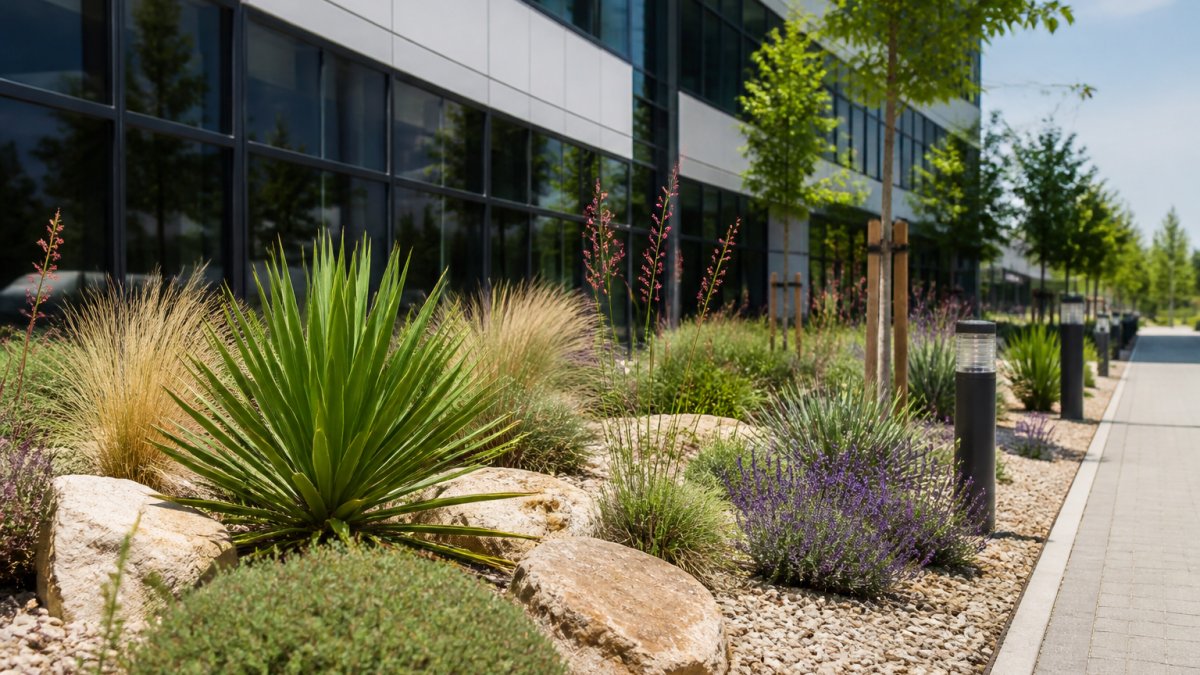
For planted areas, mulch beds annually with compost or bark. Mulch suppresses weeds, retains moisture, and slowly feeds the soil, cutting both your water bill and your herbicide use. When replacing plants, prioritise drought-tolerant species suited to your local conditions and soil type. This is also where sustainable procurement comes in: source materials from local nurseries to cut transport emissions and support regional suppliers.
Pro Tip A common mistake is treating all lawns the same. High-traffic areas near entrances need hardier grass mixes, while ornamental lawns can be cut less frequently. Adjusting your cutting schedule by zone, not by calendar, is the fastest win for both turf health and fuel use.
Step 3: Plan for Biodiversity Net Gain for Commercial Sites
Biodiversity net gain for commercial sites means leaving the natural environment in a measurably better state than before your management began. For existing sites, this does not require ripping out formal planting. It starts with protecting what is already there: retain mature trees, leave wild margins around boundaries, and avoid spraying near hedgerows.
Add structure to your planting plan to support wildlife. A mix of flowering shrubs, native hedges, and a small wildflower meadow attracts pollinators and birds while adding visual interest. Log piles and bug hotels in quiet corners provide habitat without affecting the manicured appearance of main entrances. These features also reduce the area of intensively managed lawn, which lowers your ongoing maintenance hours and input costs.
Check whether your site drains into local watercourses. Protecting hydrology matters: minimise the use of pesticides near drains and consider rain gardens or permeable surfaces to slow runoff and filter pollutants. These mitigation strategies protect you from future regulatory pressure while improving the site's resilience to flooding.
Step 4: Navigate UK Environmental Compliance for Site Managers
UK environmental compliance for site managers is governed by a framework that covers waste disposal, water pollution, and the protection of protected species. The cornerstone is your duty of care for waste: you must ensure any green waste, chemicals, or construction debris is removed by a licensed carrier and disposed of at permitted facilities. Keep waste transfer notes for at least two years as evidence of compliant disposal.
If your site borders a watercourse or contains ponds, you must not allow silty runoff or chemical washings to enter them. This is regulated under anti-pollution legislation, and enforcement can result in significant fines. Store fuels and chemicals in bunded containers, and plan spill kits for refuelling areas.
For larger projects, such as removing trees or altering land, check whether you need prior consent. Trees in conservation areas or covered by Tree Preservation Orders are protected. If your site hosts protected species like bats or great crested newts, any works affecting their habitat require careful timing and, in some cases, a licence. When in doubt, commission an ecological survey before starting works. The UK Government guidance on [biodiversity net gain(/post/is-biodiversity-net-gain-mandatory-for-offices) | gov.uk] outlines how new developments must deliver a 10% net gain, a standard that increasingly influences how commercial sites are managed and maintained.
Step 5: Budget and Track Your Sustainability Progress
Sustainability investments compete with every other line item in your facilities budget, so frame them as long-term savings rather than costs. Begin with no-cost changes: adjust mowing heights, reduce fertiliser on established lawns, and repair dripping irrigation. These require no capital and typically cut operating costs within one season.
For larger upgrades, such as installing a rainwater harvesting butt for irrigation or replacing energy-hungry hedge trimmers with battery-powered models, calculate the payback period. A simple formula is the upfront cost divided by the annual saving. If a rainwater system costs £1,200 and saves £300 per year in metered water, it pays back in four years and delivers savings thereafter.
But budgeting for sustainability is not just about payback on a single item, it is about building a business case that survives scrutiny from finance directors. A more robust approach is to calculate the total cost of ownership (TCO) over a five-year horizon. For example, switching from petrol to battery-powered hedge trimmers might cost £800 more upfront, but when you factor in fuel savings of £150 per year, reduced maintenance parts (no spark plugs, air filters, or carburettor servicing), and lower noise-related downtime, the cumulative saving often exceeds £700 over five years. Presenting this as a five-year TCO comparison, rather than a simple payback period, aligns with how capital expenditure is typically evaluated in UK facilities budgets.
To make this tangible, use a simple spreadsheet to track the 'big three' resource inputs: water (m³ per month from your meter), fuel (litres of petrol or kWh of electricity for equipment), and waste (tonnes or bin lifts sent to landfill vs. recycled). Add a column for labour hours per zone. After 12 months, you will have hard data on what works and what does not, which makes renewing your maintenance contract much easier to justify to finance directors.
Key Takeaway A common pattern among beginners is to track only spending, not resource consumption. But it is the resource data, water, fuel, waste, that reveals the inefficiencies that drive costs. Without it, you are guessing.
Technology can remove the guesswork. For beginners, the most accessible tools are not expensive enterprise platforms but cloud-based spreadsheets and free tiers of carbon calculators. The UK government's Streamlined Energy and Carbon Reporting (SECR) guidance provides a framework for calculating carbon emissions from energy use, which you can adapt for your site even if you are not legally required to report. For a more structured approach, consider using a dedicated carbon tracking tool such as the Carbon Trust's SME Carbon Footprint Calculator, which is free and designed for organisations without in-house sustainability expertise.
For sites with larger budgets or multiple buildings, Building Information Modelling (BIM) software is increasingly used to manage sustainability data. BIM is not just for architects; facilities managers can use it to overlay energy, water, and waste data onto a digital twin of the site, identifying which zones are underperforming. However, for a single office park, this is often overkill. A more proportionate step is to use a simple environmental management information system (EMIS) like the free version of EcoOnline or a bespoke spreadsheet that tracks your KPIs against your action plan.
When building your budget, also account for the hidden costs of inaction. The Environment Agency's enforcement powers under the Environmental Permitting Regulations 2016 can result in variable penalties for pollution incidents, which for a small business can run into tens of thousands of pounds. A £500 investment in a bunded fuel storage container or a properly designed spill kit is trivial compared to the potential fine and reputational damage. Similarly, failing to comply with your duty of care for waste can lead to fixed penalty notices of up to £300 per offence from your local authority.
Finally, do not forget to budget for the soft costs of transition: staff training on new equipment, signage for new waste streams, and time spent on monitoring. A realistic rule of thumb is to allocate 5-10% of your annual grounds maintenance budget to sustainability-related training and monitoring in the first year. This is not a cost; it is the insurance that ensures your other investments deliver the promised savings.
Common Mistakes to Avoid When Starting Out
The most frequent error is trying to transform the whole site at once. A full redesign is expensive, disruptive, and hard to maintain. Instead, pilot sustainable practices on one zone, prove the result, then roll it out across the estate.
A second mistake is ignoring the maintenance reality of new planting. Wildflower meadows and native hedges still need management in their first two years. Budget for weeding and watering during establishment, or the planting will fail and you will revert to expensive replacements. Similarly, do not assume "organic" means "no maintenance." Compost teas and biological controls require observation and timing to work effectively.
Finally, do not neglect emergency and contingency planning. A sustainable site often includes water features, irrigation systems, and young trees that are vulnerable during drought or extreme weather. Have a plan for hosepipe bans and heatwaves before they arrive, including which areas you will prioritise for watering and how you will protect recently planted specimens.
Conclusion: Your First 90 Days of Sustainable Site Management
Your first quarter should focus on understanding the site, not overhauling it. In the first month, complete the audit, take soil samples, and map where water and inputs are being wasted. In month two, implement no-cost changes: adjust cutting heights, introduce mulching, and set up your tracking spreadsheet. By month three, you should have a clear action plan for the following seasons, with budgeted upgrades and a timeline for introducing more significant changes.
Sustainable site management is an ongoing process, not a one-off project. Consistency matters more than perfection. A reliable maintenance schedule that follows the principles above will improve your site's environmental performance year on year while keeping it presentable for clients and staff. Working with a team that understands these practices makes the transition far simpler.
Sustainable grounds management requires specialist knowledge, from soil health to biodiversity planning. Pemigogardens provides tailored maintenance contracts for private offices and business parks across the M40/M4 corridor, with regular visits planned around your site's specific needs. Our team holds health and safety training with Human Focus, and we build sustainability into every maintenance plan without compromising on presentation. Get started with Pemigogardens and put your site on a sustainable footing this year.
Frequently Asked Questions
What are the core principles of sustainable site management?
Sustainable site management balances environmental, social, and economic factors, often called the triple bottom line. Core principles include reducing your carbon footprint, managing waste responsibly, protecting and enhancing biodiversity, and using resources like water and energy efficiently. It also involves considering your impact on the local community. Rather than a single action, it is a framework for making decisions about your grounds that aim for long-term environmental health and operational efficiency, ensuring your site remains viable and pleasant for years to come.
What UK regulations govern sustainable land management?
Key legislation includes the Environment Act 2021, which introduces mandatory biodiversity net gain for new developments, meaning a 10% improvement is required. You must also comply with the Wildlife and Countryside Act 1981 for protected species and the Clean Neighbourhoods and Environment Act 2005 for waste management. The Environmental Protection Act 1990 outlines your duty of care for waste. For site managers, staying compliant means keeping records of waste disposal and ensuring any contractors you use follow these regulations on your behalf.
How can sustainable site management improve property value?
A sustainably managed site is more attractive to tenants and clients, which can reduce vacancy rates and justify higher rents. Features like native planting, wildflower meadows, and responsible water management create a distinctive, well-cared-for impression. It also demonstrates strong governance and social responsibility, which is increasingly important for businesses. Furthermore, proactive management prevents costly issues like drainage problems or pest infestations. Over time, a healthy landscape with mature trees and good soil structure becomes an appreciating asset rather than a depreciating liability.
What are the first steps for a beginner in sustainable site management?
Start with a simple site audit. Walk your grounds and note current practices: how often you mow, how you water, and where waste goes. Identify areas with low biodiversity, such as large expanses of single-variety turf. From there, set two or three measurable goals, like reducing water use by 10% or introducing a native wildflower area. You do not need to overhaul everything at once. Small changes, such as adjusting mowing heights and scheduling, can deliver quick wins and build momentum for larger projects.
TELL US Submit
This article was written using GrandRanker


Comments