
10 Commercial Landscaping Ideas for Offices
Updated: Sep 16
Table of Contents
Why Commercial Landscaping Design Matters for Office Buildings
1. Welcoming Front Entrances with Native Plant Borders
2. Outdoor Seating and Common Areas for Employee Wellbeing
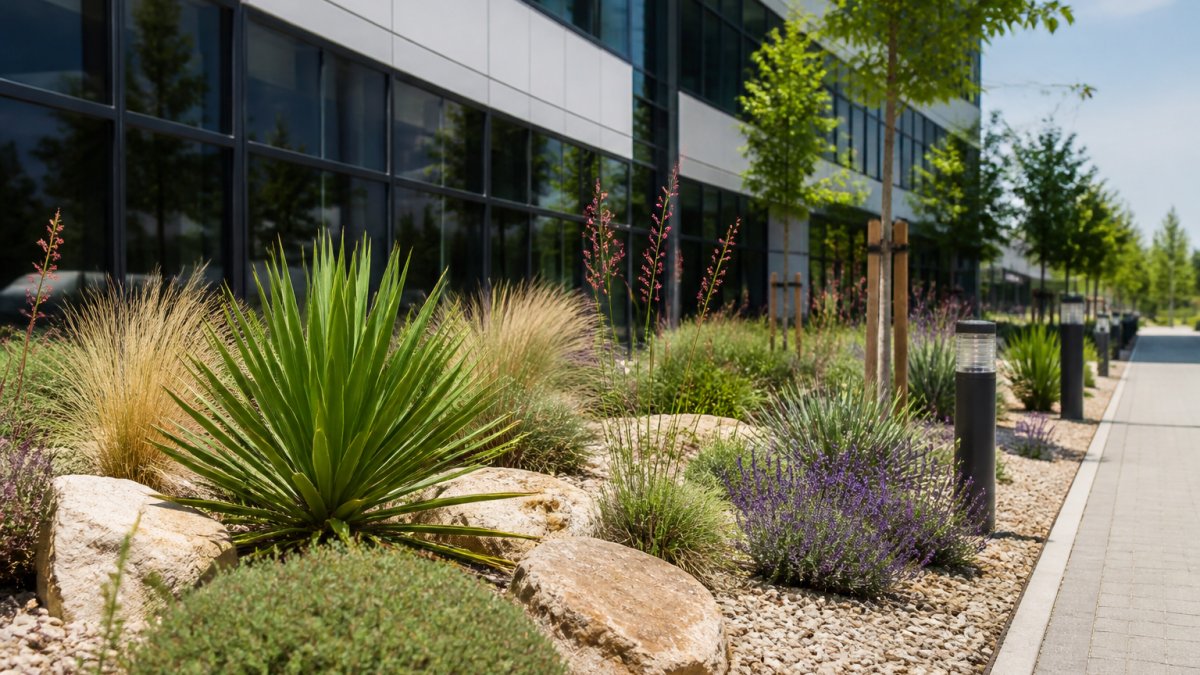
3. Sustainable Native Plant Landscapes and Xeriscaping
4. Hardscaping, Permeable Paving, and Drainage Solutions
5. Biophilic Design: Living Walls and Green Infrastructure
6. Seasonal Plantings, Pathway Design, and Landscape Lighting
How to Choose a Commercial Landscaping Contractor for Your Office
Frequently Asked Questions
Why Commercial Landscaping Design Matters for Office Buildings

Commercial landscaping ideas transform how clients and employees perceive your office building before they ever step inside. The exterior grounds are the first impression, and they signal whether your business is thriving, organised, and detail-oriented. A well-designed landscape communicates professionalism, reduces employee stress, and can measurably affect how prospects view your organisation.
The relationship between outdoor space quality and workplace productivity is direct. Employees who have access to well-maintained grounds, green infrastructure, and thoughtful biophilic design report lower stress levels and higher engagement. For office buildings competing for talent in the Thames Valley and M40 corridor, this matters considerably. Your landscape isn't decoration, it's a strategic asset that affects recruitment, retention, and client confidence.
At Pemigogardens, we've worked with private offices and business parks across Berkshire, Buckinghamshire, and Oxfordshire to design grounds that serve both aesthetic and functional purposes. The best commercial landscaping ideas balance visual appeal with practical maintenance, seasonal colour, accessibility, and long-term property value. Below, we'll walk through ten proven strategies that work for offices of all sizes.
Key Takeaway Your office landscape is the first touchpoint for clients and employees. Strategic design increases property value, improves employee well-being, and reduces long-term maintenance costs.
1. Welcoming Front Entrances with Native Plant Borders
The entrance is where curb appeal begins. Native plant borders frame your building's entry point and signal environmental responsibility to visitors. Unlike exotic ornamentals that demand constant feeding and pest management, native plants thrive in local soil conditions and require minimal intervention once established.
A welcoming front entrance uses native plant landscaping to create visual depth without overwhelming maintenance demands. Layering plants by height, ground cover, shrubs, and small trees, creates structure and draws the eye toward your door. This approach also improves drainage and reduces irrigation costs compared to traditional borders filled with high-maintenance exotics.
The practical benefit: native plants support local pollinators and reduce water consumption, which appeals to environmentally conscious clients and staff. A well-designed entrance with native borders typically costs less to maintain year-round than conventional plantings, making it a smart financial decision alongside aesthetic improvement.
2. Outdoor Seating and Common Areas for Employee Wellbeing
Outdoor workspace and common areas directly improve employee well-being and productivity. Employees who spend even 15 minutes daily in outdoor spaces report measurably lower stress and better focus when they return to their desks. For office buildings in the Thames Valley, where weather permits outdoor use most of the year, this is a significant advantage.
Effective outdoor seating areas require thoughtful placement. Position seating where it captures morning sun but offers afternoon shade, typically under a pergola, shade structure, or mature tree canopy. Include tables for informal meetings or lunch breaks. Ensure the area is visible from inside the building so employees feel safe and connected to the main facility.
Accessibility matters here too. Pathways to seating areas should be level and wide enough for wheelchairs and mobility aids. Seating should include options: benches, chairs with backs, and tables at varying heights. This inclusive design ensures all staff can benefit from the outdoor space, which improves overall workplace satisfaction and demonstrates duty of care.
Pro Tip Position outdoor seating near the building entrance rather than isolated at the back. Employees are more likely to use spaces they can see from windows and that don't require a lengthy walk.
3. Sustainable Native Plant Landscapes and Xeriscaping
Sustainable landscaping reduces operational costs whilst supporting environmental goals. Native plant landscapes and xeriscaping (water-efficient design) are increasingly expected by clients and regulators. They're also substantially cheaper to maintain than conventional grounds requiring constant irrigation, fertiliser, and pest management.
Native plants are adapted to local rainfall patterns and soil chemistry. Once established, they rarely need supplemental watering, fertiliser, or chemical treatments. For office buildings managing tight budgets, this efficiency is material.
Xeriscaping extends this logic by grouping plants by water needs and minimising turf areas. Hardscaping, permeable paving, and strategic plant selection create visually interesting grounds that consume far less water. In the Thames Valley, where water restrictions occasionally apply, this approach future-proofs your landscape against regulatory changes.
The environmental impact is also real: reduced chemical inputs mean cleaner runoff, lower carbon footprint from maintenance equipment, and improved habitat for pollinators and beneficial insects. This aligns with corporate sustainability commitments and appeals to employees who value environmental responsibility.
4. Hardscaping, Permeable Paving, and Drainage Solutions
Hardscaping, paved areas, pathways, and structures, serves both aesthetic and functional purposes. Permeable paving specifically addresses drainage challenges whilst reducing the urban heat island effect. For office parks with car parks and heavy foot traffic, proper hardscaping prevents water pooling, reduces flooding risk, and extends the life of your infrastructure.
Permeable paving materials (permeable concrete, recycled asphalt, gravel) allow water to drain through the surface into the soil below, rather than running off into drainage systems. This reduces strain on stormwater infrastructure and improves groundwater recharge. Visually, it also looks more refined than standard tarmac and requires less frequent resurfacing.
Pathway and walkway design affects both safety and user experience. Wide, level pathways with consistent materials guide foot traffic and prevent accidents. Hardscaping should connect key areas: main entrance, car parks, outdoor seating, and building exits. Clear sight lines and appropriate lighting (discussed in section 6) make pathways safe and inviting.
The drainage benefit is substantial. Properly designed hardscaping with permeable surfaces reduces pooling, prevents ice formation in winter, and extends the life of your car park and pathways. This is a long-term cost saving that often goes unnoticed until poor drainage causes expensive repairs.
5. Biophilic Design: Living Walls and Green Infrastructure
Biophilic design integrates nature into built environments, improving air quality, aesthetics, and employee psychology. Living walls, green roofs, and strategic tree placement create visual interest whilst delivering measurable environmental benefits. For office buildings competing for talent, biophilic design is increasingly expected by younger employees.
Living walls (vertical gardens) are particularly effective in urban settings where horizontal space is limited. They improve air quality by filtering pollutants, reduce interior temperatures in summer, and create striking visual focal points. A living wall near the entrance or in a common area signals environmental commitment and creates a memorable first impression.
Green infrastructure, rain gardens, bioswales, and planted drainage areas, manages stormwater whilst supporting plant growth. These features reduce flooding risk, improve water quality, and create habitat for wildlife. They're also visually interesting and break up large expanses of hardscaping.
The psychological benefit is well-documented: employees with views of green space report lower stress and higher productivity. Even small interventions, a living wall, planted buffer zones, or mature tree canopy, improve workplace satisfaction. This translates to better retention and reduced recruitment costs.
6. Seasonal Plantings, Pathway Design, and Landscape Lighting
Seasonal colour keeps your grounds visually fresh throughout the year. Spring bulbs, summer annuals, and autumn foliage create a landscape that evolves rather than remaining static. This seasonal variation also signals active maintenance and care, which improves client perception and employee morale.
Pathway and walkway design should be intuitive and safe. Clear sightlines, appropriate width (at least 1.5 metres for two-person passage), and consistent materials guide foot traffic naturally. Lighting is essential here, well-lit pathways are safer, more inviting, and extend usability into evening hours. This is especially important for office parks where employees work varied shifts or leave after dusk.
Landscape lighting serves both safety and aesthetic purposes. Uplighting on trees creates drama and draws attention to key features. Path lighting ensures safe navigation. Accent lighting on buildings or focal points creates visual interest without excessive brightness. Energy-efficient LED lighting reduces operational costs whilst delivering superior visual quality.
The maintenance consideration is practical: seasonal plantings require planning and coordination. Working with a dedicated grounds maintenance provider ensures plantings are installed, maintained, and refreshed on schedule. This consistency is what separates professional landscaping from neglected grounds.
How to Choose a Commercial Landscaping Contractor for Your Office
Selecting the right grounds maintenance provider is critical. Many office managers have experienced contractors who disappear when busier jobs arrive, or who deliver inconsistent results. The right partner ensures your landscape is maintained reliably throughout the year, not abandoned when demand spikes.
Look for a provider that specialises exclusively in commercial grounds maintenance rather than residential work. Commercial clients have different expectations: regular site visits on schedule, coordination with your facility management, and reliability even during peak seasons. A contractor focused only on commercial work has the infrastructure and discipline to meet these demands.
Ask directly about consistency and reliability. How do they manage workload during peak seasons? Do they have backup teams if the primary crew is unavailable? What happens if a team member leaves, is continuity maintained? These questions reveal whether the contractor views your site as a priority or a secondary job.
Verify that the contractor holds appropriate health and safety training. For grounds maintenance work in the UK, this includes CITB qualifications, LANTRA certifications where relevant, and current first aid training. Ask for evidence of public liability insurance and employer's liability insurance. These aren't optional, they protect both you and the contractor.
Consider whether the contractor works directly with property owners or exclusively through managing agents. Direct relationships often allow for more personalised service and faster decision-making. If you manage your own property, working directly with the landscaping team gives you control over priorities and timing.
Evaluation Criterion | What to Look For | Why It Matters |
Specialisation | Commercial grounds only (no residential) | Ensures focus on your site's needs |
Reliability | Consistent crews, backup teams, year-round availability | Prevents gaps in maintenance during peak seasons |
Safety Credentials | CITB, LANTRA, first aid, insurance verification | Protects your liability and staff safety |
Direct Relationship | Works with property owners, not just managing agents | Allows personalised service and faster decision-making |
References | Existing clients in your area (e.g., Thames Valley offices) | Demonstrates proven performance with similar sites |
Pemigogardens operates exclusively with private office owners and business parks, we don't work through managing agents, which means you work directly with the team maintaining your grounds. We focus on regular maintenance contracts within the M40/M4 corridor, where we've built relationships with clients like the Duke of Edinburgh Awards, De Le Cuona, and Adair House in Windsor. This specialisation means we understand the specific needs of Thames Valley offices and can coordinate seamlessly with your facility management.
Ask your contractor about their approach to seasonal planning. How do they decide what gets planted when? Do they work with you to choose colours and species, or do they impose standard schemes? The best contractors adapt to your preferences and budget whilst offering professional guidance on what will thrive in your specific location.
Finally, discuss maintenance frequency and what's included. Weekly visits? Bi-weekly? What does each visit cover, mowing only, or also weeding, pruning, and seasonal updates? A clear service specification prevents misunderstandings and ensures you get what you're paying for. Clarify this upfront.
Strategic commercial landscaping design improves how clients perceive your office, increases employee well-being, and protects your property value. The ten ideas covered here, from welcoming entrances to seasonal colour to proper hardscaping, work together to create grounds that reflect your business standards and support your facility goals.
The challenge isn't knowing what works; it's finding a contractor reliable enough to deliver consistently. Pemigogardens provides regular grounds maintenance contracts exclusively for private offices and business parks across the Thames Valley. Our team handles everything from tree surgery to seasonal plantings to car park maintenance, and we coordinate directly with you, no managing agents, no handoffs to junior crews. Contact Pemigogardens for a site assessment and see how strategic landscaping can strengthen your office's first impression.
Frequently Asked Questions
How does professional landscaping improve office employee wellbeing?
Access to outdoor spaces and natural elements reduces stress, improves focus, and encourages movement breaks. Biophilic design, incorporating living walls, native plants, and green infrastructure, creates a connection to nature that measurably enhances productivity and mental health. Employees with views of plants and outdoor seating areas report higher job satisfaction and lower burnout rates.
What are the key principles of sustainable commercial landscape design?
Sustainable landscaping prioritises native plants adapted to local climate, reducing irrigation needs and maintenance costs. Permeable paving manages drainage naturally, reducing flooding and urban heat island effects. Xeriscaping techniques minimise water consumption. Green infrastructure like living walls absorbs rainwater and improves air quality. These principles lower environmental impact while reducing long-term facility management costs.
How can landscaping increase the property value of a business park?
Well-designed commercial landscaping enhances curb appeal, making properties more attractive to tenants and clients. Professional hardscaping, seasonal colour, and biophilic design signal quality and investment in the site. Properties with strong landscape architecture command higher rental rates and attract premium tenants.
What should I look for when choosing a commercial landscaping contractor?
Select a contractor with proven experience in commercial grounds maintenance services who understands your specific needs, whether seasonal plantings, car park upkeep, or pathway maintenance. Ask for references from similar office properties. Verify they offer regular site visits and tailored contracts rather than generic services. Ensure they hold relevant health and safety training and can commit to consistent, reliable service throughout the year.
TELL US Submit
This article was written using GrandRanker

Comments