
Seasonal Office Landscaping Maintenance Tips: A Year-Round Guide
Table of Contents
Spring Office Landscaping Maintenance: Getting Your Grounds Ready Lawn care and aeration after winter dormancy Weed suppression and early season fertilization Pruning and shrub thinning for the growing season
Lawn care and aeration after winter dormancy
Weed suppression and early season fertilization
Pruning and shrub thinning for the growing season
Summer Grounds Maintenance: Keeping Turf and Plants Healthy Regular mowing schedules and edge trimming Irrigation system maintenance and soil health monitoring Pest and disease management during peak growth
Regular mowing schedules and edge trimming
Irrigation system maintenance and soil health monitoring
Pest and disease management during peak growth
Autumn Office Landscaping: Preparing for Dormancy Debris removal and mulching for winter protection Seasonal pruning and boundary maintenance
Debris removal and mulching for winter protection
Seasonal pruning and boundary maintenance
Winter Office Plant Care Tips for Indoor and Outdoor Areas Frost protection and winterization strategies Drainage management and site inspection during cold months
Frost protection and winterization strategies
Drainage management and site inspection during cold months
Low Maintenance Office Plants UK: Year-Round Care Guide
Office Plant Watering Guide: Seasonal Adjustments
Office Plant Care UK: Integration with Grounds Maintenance
Safety, Liability and Sustainability in Commercial Grounds Maintenance Risk reduction and property asset management Eco-friendly practices and landscape aesthetics
Risk reduction and property asset management
Eco-friendly practices and landscape aesthetics
Last Updated: August 2, 2026
Maintaining an attractive, functional office landscape throughout the year requires a strategic approach that adapts to changing seasons. At Pemigogardens, we understand that seasonal office landscaping maintenance tips are essential for private offices and business parks across the Thames Valley, where weather patterns and growing seasons demand careful planning. This guide covers the practical steps to keep your commercial grounds in pristine condition from spring through winter, protecting your property investment while enhancing curb appeal for clients and staff.
Spring Office Landscaping Maintenance: Getting Your Grounds Ready
Spring is your critical window to set the tone for the entire growing season. The soil is warming, plants are emerging, and weeds are beginning to germinate.

Lawn care and aeration after winter dormancy
Winter compaction damages turf structure, restricting water and nutrient penetration. Early spring aeration reverses this by creating channels through the soil. Aerating in March or early April, before peak growth, allows grass to establish strong root systems throughout the season.
(/post/regular-grounds-maintenance-for-offices-7-essential-benefits): Getting Your Grounds Ready]
Timing matters: aerating too early (February) hits frozen ground; too late (May) stresses heat-sensitive grasses. Apply spring fertilisation within 48 hours of aeration to support new growth with a balanced nitrogen-rich formula.
Pro Tip Apply fertiliser within 48 hours of aeration for maximum nutrient uptake. The open soil channels allow deeper penetration than surface application alone.
Weed suppression and early season fertilization
Spring weeds emerge aggressively because soil temperatures are rising and moisture is abundant. Pre-emergent herbicides applied in late March create a barrier that stops weed seeds from germinating, far more effective than reactive treatment.
For commercial office landscaping, focus on high-visibility areas first: car parks, entrance pathways, and planting beds. Mulching beds with 50-75mm of bark or wood chip suppresses weeds naturally while improving soil health. Soil testing reveals nutrient deficiencies and pH levels, ensuring your investment delivers results.
Pruning and shrub thinning for the growing season
Spring pruning shapes plants for the entire year ahead. Shrubs that have grown dense over winter benefit from thinning, removing crossing branches, deadwood, and interior growth. This improves air circulation and encourages new growth.
Prune spring-flowering shrubs (forsythia, magnolia, flowering cherry) immediately after they finish blooming, typically late April. Pruning them now removes next year's flower buds, so timing is critical. Avoid over-pruning; remove no more than one-third of the plant's growth in a single season.
Summer Grounds Maintenance: Keeping Turf and Plants Healthy
Summer is the peak growing season, when maintenance frequency increases but tasks becomes more routine. Heat stress, drought, and pest pressure all intensify during June through August.
Regular mowing schedules and edge trimming
Mow when grass reaches 50-75mm in height, typically once per week during peak growth. Never remove more than one-third of the blade height in a single cut. Edge trimming along pathways, car parks, and planting beds defines the landscape's character and creates an impression of professional management.
Cool-season grasses (common in the UK) should be maintained at 30-40mm during summer heat to reduce water stress. Taller grass shades the soil, retains moisture, and crowds out weeds.
Key Takeaway A single missed mowing creates visible deterioration that takes weeks to recover from. Consistency is non-negotiable for office landscaping maintenance.
Irrigation system maintenance and soil health monitoring
Check all sprinkler heads for blockages, misalignment, and coverage gaps. A single malfunctioning head creates brown patches within days. Monitor soil moisture by hand: squeeze a handful of soil from 100mm depth. It should feel slightly damp, not wet or dusty.
Mulch plays a critical role in summer soil health. A 50-75mm layer of organic mulch reduces soil temperature by 5-8°C, cuts water loss by 50%, and feeds the soil as it breaks down. Refresh mulch annually in spring to maintain depth.
Pest and disease management during peak growth
Summer heat and humidity create ideal conditions for fungal diseases and pest outbreaks. Walk your site weekly during summer, looking for yellowing leaves, unusual spotting, or visible pest colonies. Many problems are treatable in early stages with targeted intervention.
For office landscaping, avoid broad-spectrum pesticides. Use targeted treatments: neem oil for soft-bodied insects, sulphur for fungal diseases, and horticultural soap for mites. These are less toxic and more sustainable.
Autumn Office Landscaping: Preparing for Dormancy
Autumn is the second-most critical maintenance season. Work done in September and October determines how well your landscape survives winter and emerges in spring. Deciduous trees and shrubs begin moving energy reserves into roots in late August, making this the ideal time for planting new specimens.
Debris removal and mulching for winter protection
Remove fallen leaves from lawns weekly; leave them in planting beds where they break down and feed the soil. Mulching beds with fresh organic material in autumn insulates soil against frost, suppresses winter weeds, and provides organic matter for spring growth. Apply 75-100mm of bark or wood chip around shrubs and perennials, keeping it 100mm away from plant stems.
For office landscaping, autumn cleanup is visible to clients. Clear fallen branches, remove dead plants, and tidy planting beds to signal active, professional grounds maintenance.
Seasonal pruning and boundary maintenance
Late autumn is ideal for pruning deciduous trees and shrubs. Once leaves have dropped, you can see the plant's structure clearly. Remove crossing branches, deadwood, and branches that obstruct sightlines or pathways.
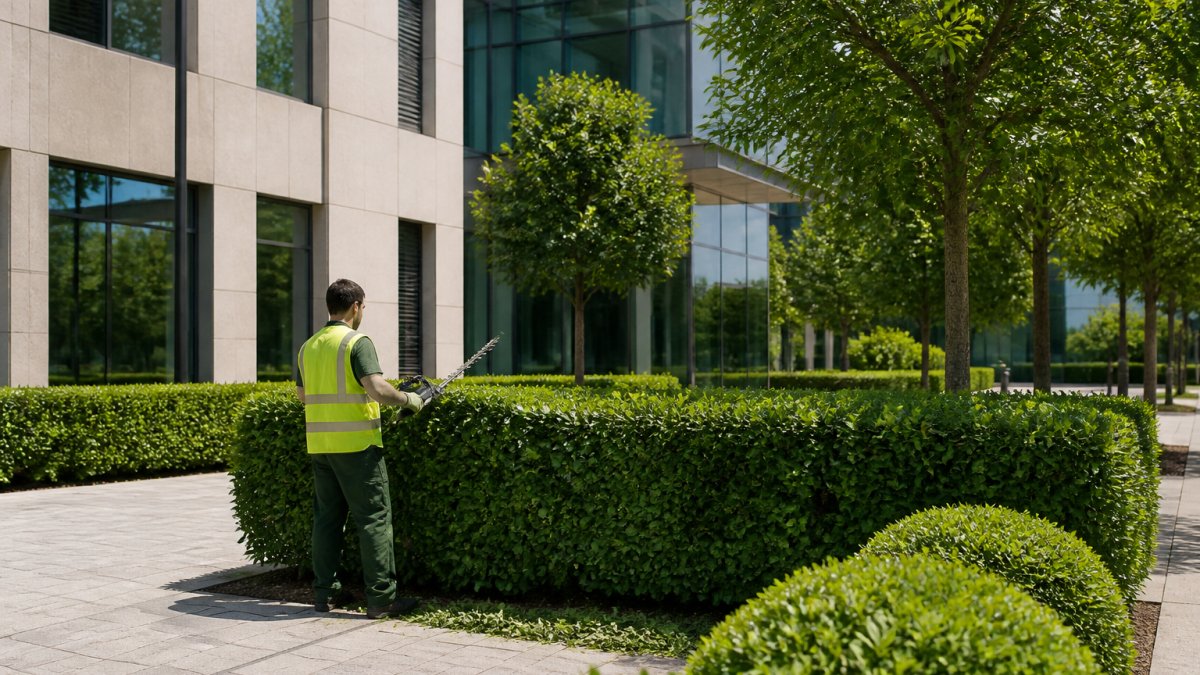
Trim hedges for the final time before winter, typically late September or early October. This allows new growth to harden before frost. Check fencing, gates, and boundary features for damage from summer growth and repair before winter weather stresses them further.
Winter Office Plant Care Tips for Indoor and Outdoor Areas
Winter is the dormant season for most outdoor plants, but it requires active management. Cold, frost, and waterlogging create new challenges.
Frost protection and winterization strategies
Wrap young trees with hessian or frost cloth in November; remove wrapping in March when frost risk declines. This prevents sun scald and wind damage. Ensure all low-lying areas have adequate drainage; waterlogged soil freezes solid and kills roots. Clear blocked drains and gullies in November before heavy winter rains.
Monthly site inspections during winter (December, January, February) identify storm damage, fallen branches, and winter die-back. Early intervention prevents spring problems. Winter is also the ideal time for planning spring improvements.
Low Maintenance Office Plants UK: Year-Round Care Guide
Indoor office plants require minimal intervention when matched to their environment. Pothos, snake plant, and peace lily tolerate low light and irregular watering, ideal for commercial spaces. These plants improve air quality by filtering formaldehyde and benzene.
Match plants to available light. North-facing offices need shade-tolerant plants; south-facing offices can support sun-lovers. Most office plants die from overwatering, not neglect. Allow soil to dry between waterings; stick your finger 25mm into the soil, if it feels moist, don't water.
Office Plant Watering Guide: Seasonal Adjustments
Watering needs change dramatically across seasons.
Spring and summer (March-September): Plants are actively growing. Check soil moisture twice weekly. Most office plants need watering once weekly or every 5-7 days.
Autumn (September-November): Growth slows as day length decreases. Reduce watering frequency to once every 10-14 days.
Winter (December-February): Most office plants are dormant. Reduce watering to once every 2-3 weeks. Overwatering in winter causes root rot.
Early spring (February-March): Gradually increase watering frequency over 4-6 weeks as day length increases.
Season | Watering Frequency | Soil Moisture Target | Common Mistake |
Spring | Every 5-7 days | Moist, not waterlogged | Inconsistent watering |
Summer | Every 5-7 days | Moist, not waterlogged | Letting soil dry completely |
Autumn | Every 10-14 days | Slightly drier than spring | Watering on old schedule |
Winter | Every 14-21 days | Barely moist | Overwatering dormant plants |
Office Plant Care UK: Integration with Grounds Maintenance
Indoor and outdoor plants work together to create cohesive, professional environments. A unified grounds maintenance approach manages indoor plant displays, exterior planting beds, and turf as interconnected systems. When your maintenance team monitors both indoor and outdoor plants, they catch problems early.
For office parks with multiple buildings, centralised plant management reduces costs and improves consistency. One team manages all indoor displays and all exterior landscaping, ensuring professional standards across the entire site.
Safety, Liability and Sustainability in Commercial Grounds Maintenance
Professional grounds maintenance requires attention to safety, legal liability, and environmental impact.
Risk reduction and property asset management
Overgrown vegetation that obstructs sightlines increases accident risk; property owners are liable for injuries resulting from poor maintenance. Regularly trimmed hedges, clear pathways, and well-maintained surfaces reduce slip-and-fall incidents.
Pemigogardens operates with full health and safety training through Human Focus, ensuring all work meets industry standards. Tree management carries particular liability; diseased or unstable trees pose hazards. Annual tree inspections identify problems before they become dangerous.
Maintain records of all maintenance activities: aeration dates, fertiliser applications, pest treatments, pruning work. These records demonstrate due diligence and prove compliance with industry standards.
Eco-friendly practices and landscape aesthetics
Sustainability and professional appearance align perfectly in modern grounds maintenance. Organic mulching improves soil health while reducing chemical inputs. Native plant species require less water and fertiliser. Integrated pest management controls problems without broad-spectrum pesticides.
Water conservation is increasingly important. Drip irrigation delivers water directly to plant roots, reducing waste by 50% compared to overhead sprinklers. Mulching reduces irrigation demand by retaining soil moisture.
Watch Out Broad-spectrum pesticides and herbicides harm beneficial insects, soil microbes, and water quality. They also create regulatory compliance issues under the Environmental Permitting Regulations 2016. Targeted, low-toxicity treatments are legally safer and environmentally responsible.
Seasonal office landscaping maintenance tips succeed when implemented consistently by a team committed to your specific site. Property managers across the Thames Valley face identical seasonal challenges: spring compaction, summer drought, autumn debris, and winter damage. The difference between neglected grounds and professional landscapes is structured, season-by-season attention.
Pemigogardens delivers exactly this approach. Operating exclusively within the M40/M4 corridor, we provide regular site visits throughout the year, tailored maintenance contracts matched to your specific needs, and comprehensive services including tree surgery, cleaning, and clearance. We work directly with private offices and business parks, never through managing agents, ensuring you speak with the team doing the work.
When you commit to a maintenance contract with Pemigogardens, you're building a partnership with a team that understands your site, your standards, and your timeline. References from clients including the Duke of Edinburgh Awards, De Le Cuona, Adair House in Windsor, and Comino House in Bourne End demonstrate our reliability.
Get started with Pemigogardens and transform your office grounds into a professional asset that enhances client impressions year-round. TELL US Submit your site requirements and we'll design a maintenance schedule built for your specific landscape.
Frequently Asked Questions
What is the best seasonal office landscaping maintenance schedule for the M40/M4 corridor?
Spring maintenance should focus on aeration, weed suppression, and fertilization as growth begins. Summer requires regular mowing, irrigation checks, and pest monitoring during peak growth. Autumn involves debris removal, mulching, and preparation for dormancy. Winter maintenance concentrates on drainage, site inspections, and frost protection. Tailoring this schedule to your specific office property ensures optimal landscape aesthetics and curb appeal year-round.
How often should office plant watering guide schedules change seasonally?
Watering frequency drops significantly in winter when plants enter dormancy and evaporation slows. During spring and summer, more frequent watering is needed to support active growth. Autumn transitions plants gradually toward reduced water needs. Check soil moisture before watering rather than following a fixed schedule. Indoor office plants may need less frequent watering in winter due to lower temperatures and reduced light, whilst outdoor plants depend on rainfall and drainage conditions.
Which low maintenance office plants UK recommendations work best for commercial properties?
Hardy plants like evergreen shrubs, ornamental grasses, and structured hedging require minimal intervention whilst maintaining landscape aesthetics. These plants tolerate variable weather, reduce fertilization demands, and integrate well with grounds maintenance schedules. They support curb appeal without demanding frequent pruning or specialised care. Selecting low-maintenance species reduces overall site inspection time and labour costs whilst ensuring your office grounds remain presentable throughout the year.
How can direct grounds maintenance contracts improve reliability compared to managing agent arrangements?
Direct contracts with dedicated landscaping teams ensure consistent site visits, personalised service tailored to your specific office needs, and direct accountability. Unlike managing agent arrangements where responsibility is shared, direct contracts mean your team shows up on scheduled days without competing priorities. You work with the same crew, they understand your property's unique requirements (car park sweeping on Thursdays, seasonal planting preferences), and there's no risk of being handed off to subcontractors or junior staff you haven't vetted.
This article was written using GrandRanker


Comments