
Reliable Grounds Maintenance for Offices: A Complete Guide
Updated: Sep 16
Table of Contents
Why Reliable Grounds Maintenance for Offices Matters to Your Business
Essential Commercial Grounds Maintenance Services You Need
Lawn Care and Turf Management
Hard Surface Cleaning and Car Park Maintenance
Seasonal Planting and Hedge Trimming
Winter Gritting and Snow Clearance
Commercial Landscaping Health and Safety Regulations You Must Follow
Building Your Grounds Maintenance Contract Checklist
Service Scope and Frequency
Reliability and Consistency Standards
Insurance, Accreditation, and Compliance
Seasonal Maintenance Schedules for Year-Round Site Presentation
How to Evaluate Contractor Reliability and Avoid Service Failures
Conclusion
Last Updated: August 15, 2026
Why Reliable Grounds Maintenance for Offices Matters to Your Business
Your office's exterior tells a story before anyone walks through the door. A well-maintained grounds maintenance for offices operation creates immediate credibility with clients, partners, and employees. The difference between a neglected property and a professionally maintained one isn't subtle, it shapes how people perceive your entire business.
Curb appeal directly influences business outcomes. Properties with poor landscaping and unkempt grounds signal operational indifference to visitors. Conversely, a site with manicured lawns, clean car parks, and trimmed hedges communicates professionalism and attention to detail. This matters more than most facility managers realise because first impressions happen in seconds, and they're difficult to reverse.

Beyond aesthetics, reliable grounds maintenance protects your investment. Regular upkeep prevents costly damage: unchecked weeds invade paving, overgrown vegetation damages gutters and roofing, and poorly maintained car parks develop dangerous potholes. A scheduled maintenance programme costs far less than emergency repairs or property devaluation.
Health and safety compliance adds another critical layer. According to Health and Safety Executive guidance on workplace safety, organisations must maintain safe external environments. Slippery surfaces, overgrown vegetation blocking pathways, and debris create liability risks. Professional grounds maintenance contractors understand these obligations and manage them systematically.
Key Takeaway A neglected property costs more in the long run, through emergency repairs, reduced property value, and lost business opportunities, than a structured maintenance programme ever will.
Pemigogardens works exclusively with private offices and business parks across the Thames Valley, delivering reliable grounds maintenance for offices that keeps your site presentation consistent year-round. Unlike managing agents who spread resources across multiple properties, direct partnerships ensure your site gets genuine priority and tailored attention.
Essential Commercial Grounds Maintenance Services You Need
Professional grounds maintenance for offices encompasses far more than occasional mowing.
Lawn Care and Turf Management
Regular lawn care maintains the foundation of your commercial landscaping. This includes scheduled mowing at appropriate intervals, edging to define borders, weed control to prevent invasive growth, and fertilisation to keep grass healthy and vibrant.
Frequency matters. During growing season (spring through early autumn), most office properties benefit from weekly or fortnightly cuts. Winter schedules reduce to monthly maintenance as growth slows. A professional contractor adjusts frequency based on weather and grass condition rather than following a rigid calendar.
Weed control in turf requires precision. Selective herbicides target broadleaf weeds without damaging grass, whilst mechanical removal works for isolated problem areas. Left unchecked, weeds spread rapidly and devalue the appearance of your entire grounds maintenance for offices operation.
Hard Surface Cleaning and Car Park Maintenance
Car parks endure constant wear. Tyre marks, oil stains, algae growth, and debris accumulate quickly. Rotary-brush cleaning removes these effectively, restoring the professional appearance clients expect. Regular cleaning prevents staining from becoming permanent and reduces slip hazards from algae and moss growth.
Sweeping removes litter and debris that damage the site presentation. Many facilities managers underestimate how much this single task influences visitor perception. A debris-free car park reads as well-managed; a littered one signals neglect.
Paved areas, pathways, loading zones, entrance courts, require the same attention. Weed growth through cracks, moss on shaded surfaces, and accumulated dirt degrade these spaces quickly. Scheduled cleaning keeps hard surfaces safe and professional-looking.
Seasonal Planting and Hedge Trimming
Seasonal planting adds colour and interest to your site whilst signalling active maintenance. Spring bedding, summer displays, and autumn plantings demonstrate ongoing investment in your property. This matters for commercial property perception, it shows the site is actively managed and cared for.
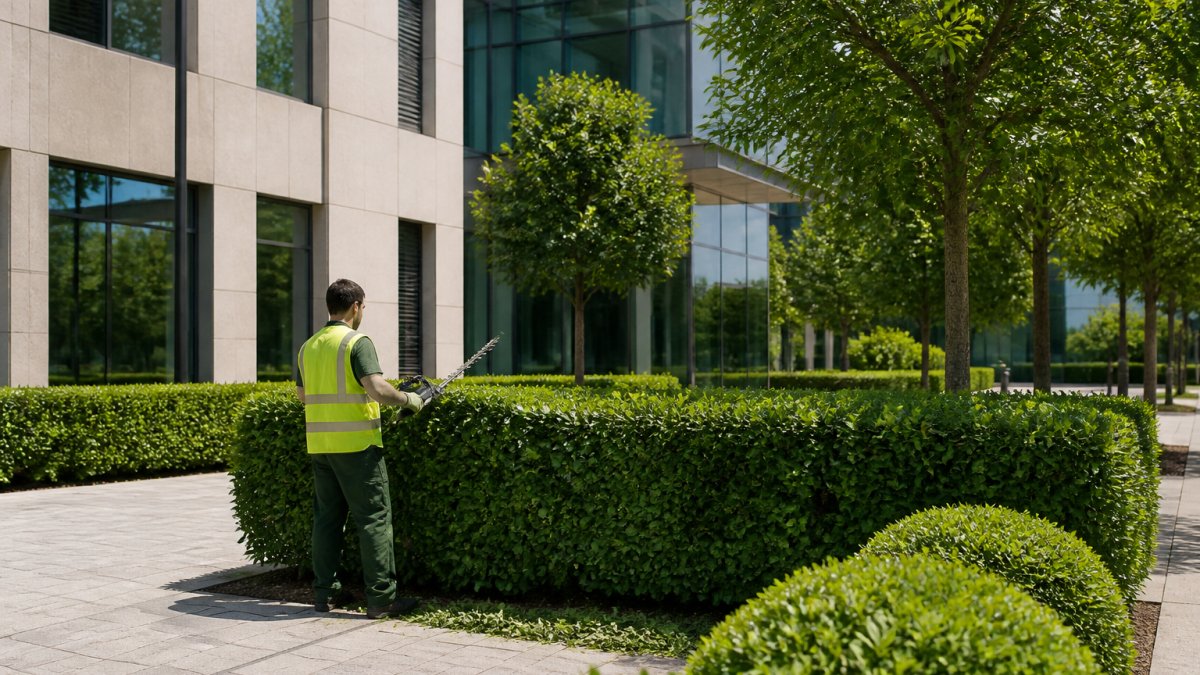
Hedge trimming maintains structure and prevents overgrowth that blocks views, damages fencing, or encroaches on pathways. Professional trimming shapes hedges to enhance the site's appearance whilst promoting healthy growth. Neglected hedges become woody, sparse, and unsightly.
Tree surgery and vegetation management require specialist knowledge. Dead branches pose safety risks; overgrown limbs damage gutters and and roof lines; diseased trees spread problems to surrounding landscape. A reliable contractor identifies these issues before they become expensive problems.
Winter Gritting and Snow Clearance
Winter presents distinct challenges. Gritting prevents ice formation on car parks, pathways, and entrance areas, a critical health and safety obligation. Snow clearance ensures access remains safe and unobstructed. Delays in winter services can trap staff and clients on your property or create dangerous conditions.
Professional winter maintenance operates on responsive schedules. Rather than applying grit on fixed dates, contractors monitor weather forecasts and treat surfaces when conditions demand it. This approach prevents unnecessary applications whilst ensuring protection when needed.

Commercial Landscaping Health and Safety Regulations You Must Follow
Your grounds maintenance contractor must operate within strict health and safety frameworks. The Health and Safety at Work etc. Act 1974 and associated regulations establish your organisation's duty to maintain safe premises. This extends to external areas.
Health and Safety Executive workplace safety standards require hazard identification and risk management. Overgrown vegetation blocking emergency exits, loose paving creating trip hazards, and poorly maintained surfaces all constitute breaches. Your contractor must demonstrate competence in identifying and managing these risks.
Contractors themselves require appropriate training and insurance. Professional teams hold health and safety qualifications, Pemigogardens staff complete training with Human Focus, ensuring they understand workplace safety obligations and operate accordingly. This protects both your site and the contractors working on it.
Insurance and accreditation provide verification of professional standards. A fully insured contractor with relevant accreditations demonstrates commitment to proper practice. Request evidence of public liability insurance, employers' liability cover, and any relevant professional memberships before engaging any contractor.
Documentation matters. A formal service level agreement (SLA) outlines responsibilities, frequencies, and standards. This creates accountability and provides clarity if disputes arise. Without a documented SLA, expectations remain vague and service quality becomes inconsistent.
Building Your Grounds Maintenance Contract Checklist
A well-structured contract protects both parties and ensures consistent service delivery.
Service Scope and Frequency
Define exactly what's included. List every service: lawn mowing frequency, hedge trimming schedules, car park cleaning, seasonal planting, winter gritting protocols, and any specialist work like tree surgery. Vague contracts lead to misunderstandings and poor service.
Specify frequencies clearly. "Regular mowing" is meaningless; "weekly mowing March through October, fortnightly November through February" is precise. Include trigger points for responsive services: "Gritting applied when temperatures forecast below 2°C or ice is visible."
Include seasonal variations. Your grounds maintenance for offices needs differ dramatically between seasons. Document these explicitly so the contractor understands expectations throughout the year.
Service | Frequency | Responsibility | Standard |
Lawn mowing | Weekly (growing season) | Contractor | Even cut, edged borders |
Hedge trimming | Quarterly | Contractor | Shaped, no overgrowth |
Car park cleaning | Monthly | Contractor | Debris-free, no stains |
Gritting | As weather requires | Contractor | Applied before ice forms |
Seasonal planting | Spring, summer, autumn | Contractor | Colour display, healthy plants |
Reliability and Consistency Standards
Reliability is non-negotiable. Your site depends on consistent service. Include specific standards: "Contractor will not cancel scheduled visits except for severe weather; notice of rescheduling provided minimum 24 hours in advance."
Define what happens when service fails. If mowing is missed, when is it rescheduled? If winter gritting isn't applied and ice forms, what's the remedy? Clear consequences encourage reliability.
Watch Out A contractor who frequently reschedules or misses visits signals deeper problems. This behaviour typically worsens over time as their business grows and your site becomes lower priority. Reliability is the single most important predictor of long-term satisfaction.
Request references from existing clients. Speak directly with facility managers at other sites. Ask specifically: "Do they show up consistently? Have you ever had to chase them for service? Would you recommend them?" Direct feedback reveals patterns.
Insurance, Accreditation, and Compliance
Request copies of public liability insurance (minimum £6 million cover for grounds maintenance work). Employers' liability insurance is essential if the contractor employs staff. Check that policies are current and cover the specific work being performed.
Accreditation varies by speciality. Tree surgery requires NPTC or equivalent qualifications. Pesticide application (if used for weed control) requires appropriate certification. Ask what training your contractor holds and request evidence.
Health and safety competency matters. Pemigogardens staff complete Human Focus health and safety training, ensuring they understand workplace obligations and manage risks appropriately. This demonstrates professional standards.
Seasonal Maintenance Schedules for Year-Round Site Presentation
Effective grounds maintenance for offices operates on seasonal cycles, not fixed annual patterns.
Spring (March-May): Growth accelerates. Lawn mowing increases to weekly frequency. Seasonal bedding is planted. Hedges are trimmed to shape and encourage growth. Winter damage is assessed and repaired.
Summer (June-August): Peak growth requires consistent mowing (weekly), regular watering for new plantings, and ongoing weed control. Car park cleaning becomes more frequent as usage increases. Hard surface algae growth accelerates on shaded surfaces.
Autumn (September-November): Leaf clearance becomes essential, accumulated leaves block drains and create slip hazards. Summer bedding is replaced with autumn plantings. Mowing frequency reduces as growth slows. Hedges receive final trim before winter.
Winter (December-February): Gritting and snow clearance dominate. Mowing reduces to monthly or as-needed basis. Evergreen plantings provide colour. Winter damage to trees and structures is monitored.
A contractor who understands these cycles delivers appropriate service at each season rather than applying a one-size-fits-all approach. Discuss seasonal planning explicitly during contract negotiation.
How to Evaluate Contractor Reliability and Avoid Service Failures
Reliability separates professional contractors from unreliable operators. Several factors predict consistent performance.
Longevity and track record: How long has the contractor operated? Businesses that survive more than five years typically have systems and client bases that support reliability. New operations, whilst potentially capable, lack proven track records.
Direct client relationships: Contractors who work directly with property owners (rather than through managing agents) typically demonstrate higher reliability. Direct relationships create accountability, if your site is neglected, you notice immediately and can address it directly.
Specialist focus: Contractors specialising in grounds maintenance for offices understand commercial standards better than generalists. Pemigogardens focuses exclusively on private offices and business parks, ensuring deep expertise in commercial property needs.
Team stability: Ask whether the same team will service your site consistently or if different crews rotate. Consistent teams develop familiarity with your property and deliver better results.
Documentation and communication: Professional contractors provide written schedules, completion reports, and responsive communication. If a contractor resists documenting service or rarely communicates proactively, this signals potential problems.
Response to concerns: How does the contractor handle complaints? A reliable operator addresses issues promptly and transparently. A defensive or slow-to-respond contractor indicates deeper reliability issues.
Pro Tip Request a trial period before committing to a long-term contract. A three-month trial reveals whether the contractor's service matches their promises. This investment in vetting prevents the frustration and expense of switching contractors mid-year.
According to British Institute of Facilities Management guidance on contractor management, regular performance reviews protect service quality. Schedule monthly or quarterly reviews to assess whether standards are being met. Document feedback and agreed improvements. This creates accountability and prevents gradual service degradation.
Reliable grounds maintenance for offices isn't a commodity service, it's a strategic investment in your property's value, safety, and professional image. The difference between adequate and exceptional service lies in contractor reliability, clear expectations, and ongoing oversight.
Pemigogardens delivers this through direct partnerships with private offices and business parks across the Thames Valley. By focusing exclusively on regular maintenance contracts and avoiding the fragmentation of managing-agent relationships, we ensure your site receives consistent, tailored attention throughout the year. Our team holds health and safety training with Human Focus, demonstrating professional competence and commitment to workplace safety standards.
If your current grounds maintenance provider has disappointed you with inconsistency or poor service, consider a direct partnership. Commercial property maintenance best practices emphasise the importance of reliable, specialist contractors. Get in touch with Pemigogardens to discuss how we can transform your site's appearance and reliability.
Frequently Asked Questions
What services are typically included in reliable grounds maintenance for offices?
Professional grounds maintenance for offices covers lawn mowing and turf care, hedge trimming and tree pruning, hard surface and car park cleaning, seasonal planting, and winter gritting or snow clearance. Services are scheduled regularly throughout the year to maintain professional appearance and site safety. A reliable contractor tailors the scope to your specific property needs and business requirements.
How often should office grounds be maintained for a professional appearance?
Most office properties benefit from weekly or fortnightly lawn maintenance during the growing season (spring through autumn), with reduced frequency in winter. Car parks and hard surfaces typically need cleaning every 2-4 weeks. Hedge trimming and seasonal planting occur on a quarterly or annual schedule. A dedicated contractor adjusts frequency based on weather, site usage, and your business calendar to ensure grounds always reflect your professional standards.
What are the main legal health and safety requirements for office grounds maintenance?
Under the Health and Safety at Work etc. Act 1974, property owners must ensure grounds are maintained safely. This includes removing hazards like uneven surfaces and overhanging branches, maintaining safe access routes, managing gritting and snow clearance in winter to prevent slips, and ensuring contractors hold appropriate insurance and training. Your contractor should be fully insured, hold relevant health and safety certifications, and conduct risk assessments for all work.
How do I know if a grounds maintenance contractor will actually show up consistently?
Look for contractors who work exclusively with private offices and business parks rather than juggling multiple client types. Request references from existing clients and ask specifically about consistency and reliability. A dedicated team that commits to regular maintenance contracts (rather than ad-hoc jobs) has stronger incentive to maintain schedules. Verify they hold formal health and safety training and are fully insured, which signals professional standards and accountability.
Why does grounds maintenance cost more when we could get a cheaper quote elsewhere?
Reliable grounds maintenance for offices reflects the value of consistency, professional standards, and accountability. Cheaper providers often cut corners by using subcontractors, rushing jobs, or deprioritising your site when busier work appears. A dedicated team that commits exclusively to private offices ensures you receive the same trained staff, comprehensive insurance, health and safety compliance, and proven reliability. The investment protects your business image, ensures compliance, and eliminates the cost of service failures.
TELL US Submit
This article was written using GrandRanker


Comments